

Director, Winner of the International Film Festival "Won Together" for Outstanding Contribution to Documentary Cinema, Andrey Osipov — on How to Preserve the Memory of the Past, and on the Importance of Film Festivals for the Formation of a Director
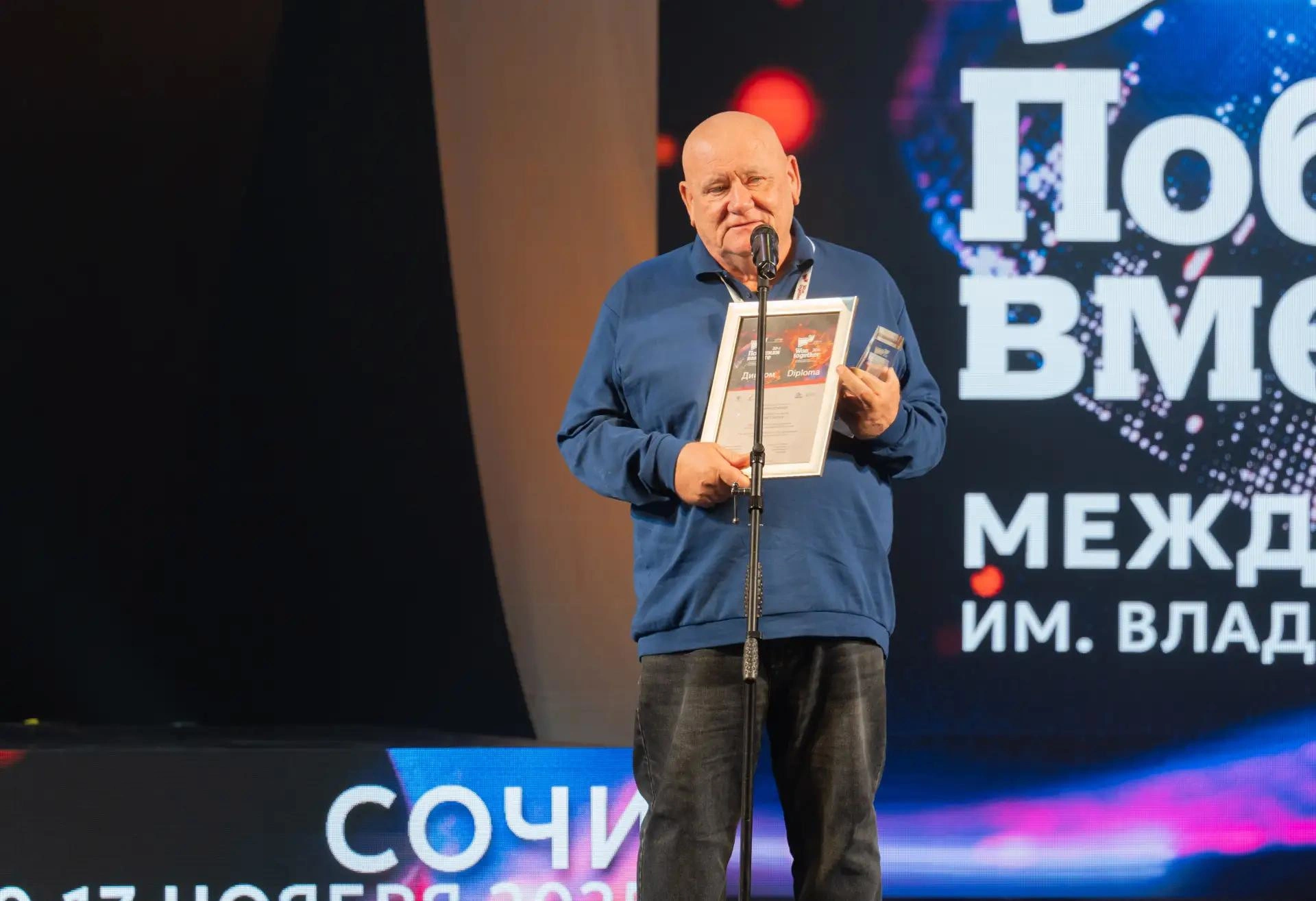
Andrey Osipov — Honored Art Worker of the Russian Federation, laureate of the Government of the Russian Federation Prize, national awards "Nika," "Golden Eagle," "Lavrovaya Vetv," member of the Expert Council of the Ministry of Culture of the Russian Federation on non-fiction cinema, the National Academy of Motion Picture Arts and Sciences of Russia, the Russian Academy of Cinematographic Arts; director of non-fiction films "Voices," "Passion for Marina," "Koktebel Pebbles," "The Stubborn Khutsiev," "Parajanov. Tarkovsky. Antipenko. Chiaroscuro," "Shaman," "The Eternal Fatherland," "Moon Phase," and others; teacher at VGIK, whose students are participants and laureates of the "Won Together" film festival.
Film scholar Elena Ulyanova spoke with the director ahead of the XXI Vladimir Menshov International Film Festival "Won Together".
— Andrey Vladimirovich, in 2025 you received the prize for contribution to documentary cinema at the "Won Together" film festival. You are a laureate of many festivals, with "Nika" and "Golden Eagle" in your creative portfolio — what does this new award mean to you?
— It was unexpected when I was called to the stage and the outstanding director Valery Timoshchenko said very warm words and handed me the prize… But it is important to note here that this is not only my award. If we recall Andrei Tarkovsky, he never said: "I made a film, this is my film," he always said: "We made a film." And that is right, because cinema is a collective endeavor, so if I have deserved an award, it is an assessment of the work of a large team from different studios over many years. And, of course, I must remember my outstanding directing master, whom I studied under at the Higher Directing Courses — Evgeny Tashkov, the author of wonderful films "The Adjutant of His Excellency," "Come Tomorrow," "The Adolescent," "French Lessons"… Evgeny Ivanovich shared his experience with us with all his open soul, taught us, and then worried — what would become of us. I hope I did not let him down. Of course, in many ways this is his contribution, and also that of the playwright Odelsha Agishev, with whom I made many of my films, and of the studios "Risk" and "Point of View."
— You spend a lot of time at film festivals, both as a film author and as a jury member. Don't you think there are too many of them? What, in your opinion, does a film festival give to a director and to audiences?
— I would like to recall the wonderful words of Andrei Bely, which he said back at the beginning of the century: "Cinema is the ideal art for the lonely. It returns to people the love of life." And a film festival, it seems to me, revives the love of cinema — both for directors and for audiences. Any festival, like a good journey, has three stages. You have made a film, you send it to a festival, and then you worry and wait for what the selection committee will say, because you know — if they accept it, there will be meetings, contacts, conversations, colleagues will share new ideas and opinions about your film. Then comes the second stage — the festival itself: those very meetings, acquaintances, communication. When the festival ends, everyone parts with sadness, but this sadness is bright, because memory remains. And then — the third stage, when you and your friends recall festival films, meetings, communication, look at the prizes on your shelf, if you managed to receive any. It gives additional strength to keep working.
There is another important aspect to festivals — they connect authors with audiences. Because often, after watching a good film, you want to immediately share what you saw with someone, talk with the director, communicate with the audience, with each other…
— And what do you remember about the "Won Together" festival? What does it mean to you as a documentary director?
— "Won Together" is one of the favorites and most important festivals for filmmakers, especially those engaged in documentary cinema. For two decades now, it has been connecting directors, cinematographers, playwrights, producers, journalists, artists, expanding for all of us the horizons of emotional and informational contact with reality. The films presented at this festival are made by directors not formally. Each work has been felt by the author, who shared what troubles and concerns him. The films shown at "Won Together" make and teach the viewer to think, to be able to compare events, times, and epochs.
Of course, a special role is played by the themes of the festival's works. Here they are connected with our history, with important turning points in the life of the country, and, of course, with outstanding people who left a significant mark. And, undoubtedly, a separate function of the festival consists in expanding the cinematographic space of influence.
It is very important that the festival bears the name of the wonderful director, People's Artist of Russia Vladimir Menshov, who always made films for audiences. I especially value the prize of the festival president for our series "The Eternal Fatherland," which we received several years ago from the hands of Vladimir Menshov himself. This award gives strength to move forward, as if saying that we have chosen the right path.
I also consider it very important that the festival always supports beginning directors and discovers new names. From our workshop these were Alexander Zharov, Viktor Zhidkov, Miroslav Blazhivsky, and Maria Vasilyeva.
— Why is it important for audiences to watch documentary cinema?
— It seems to me that often what is important is not what we see on the screen, but what remains in us after viewing, how the film changes us, how we, interacting with it, discover ourselves on a new level, hitherto unknown to us. I am sure that films often change us at least for a moment, so what is seen on the screen remains in memory forever. Every year, more and more new viewers become acquainted with cinema, discover deep emotional themes and stories for themselves. And, most importantly, viewers recognize in this themselves, their fate, their experience, their sorrows, grievances, victories, and achievements. Cinema, like no other art, brings people closer together and unites them.
— As a documentary filmmaker, you work a lot with archival footage. Why is it important for cinema, and what does it give you personally?
— A film, turning the pages of the past, reminds us where we come from, why and for what purpose, where our mentality, character, habits, and values originate. It seems to me that in films where archival footage is used, it serves not merely as illustrative material, but also helps to comprehend the past, transmits new ideas, themes, and experiences. Time changes, we change, and each time new meanings appear in the archival footage.
In the films of the "Won Together" festival, these meanings are always present, because directors do not simply illustrate bygone events with archival footage, but see and feel something more subtle, deep, essential, important — our essence, our support, our foundation, which is already behind us. Memory — it is alive, it is necessary for us, both for those who have passed away and for us, so as not to turn off the road along which past generations walked.
Let us recall that the XXI Vladimir Menshov International Film Festival "Won Together" will be held in Moscow and Sochi from September 14 to 24.
The event will bring together documentary filmmakers from more than 40 countries and 39 cities of Russia, revealing in their works the themes of victory in various spheres of life, peacemaking, religious tolerance, and humanism.
The organizers of the film festival are the World Peoples Assembly, the Administration of the City of Sochi, the production center "Integration," the Eurasian Academy of Television and Radio, and the company "Intellectual Resource," with the support of the Ministry of Culture of the Russian Federation and the World Public Assembly.
Partners: The Union of Cinematographers of the Russian Federation, the Regional Cinema Support Fund, the "Film School" project, the Sochi Institute of RUDN University, the Center for Creative Industries of the International Research Institute for Management Problems, the "Memory of Victories" Fund.
Media partners: the "Argumenty i Fakty" publishing house, TV channels OTR, MIR, VGTRK: "Vesti Sochi," the "InterMedia" news agency, the portals "Novosti Sochi," "Kultura.rf," "Literaturnaya Gazeta," "Utro.ru," IPQuorum, "Rabotniki TV," "Set Istorii," Moviestart.
Additional information is available on the official websites of the Film Festival and the World Peoples Assembly, as well as at media@world-assembly.org.
Accreditation: media@world-assembly.org.