

 Back to news
«Peace Begins with a Person»: Experts from Different Countries Named Compassion the Main Force of the New World Order
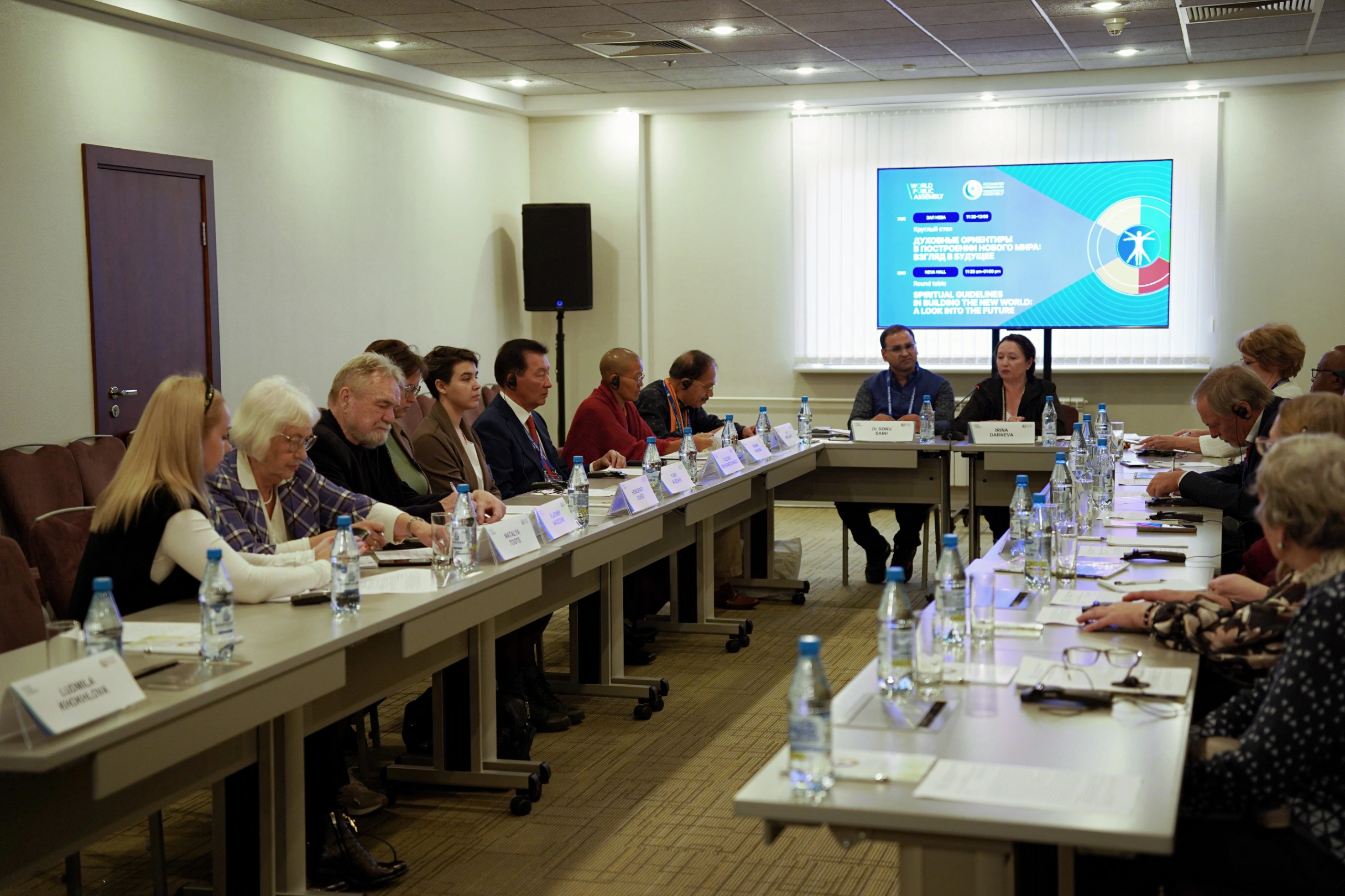
The round table «Spiritual Guidelines in Building the New World: A Look into the Future» was held on September 19, 2026, at the World Trade Center. The event was part of the Second World Public Assembly «New World: Values That Unite» held in Moscow in September 2026.
The experts discussed how to combine the potential of science, religion, and art to create long-term institutions of peace, drawing on successful humanitarian practices and the opportunities of the World Peoples Assembly. The participants paid particular attention to the challenges of the times: how to preserve the living thread of spiritual heritage – from one’s native language to the wisdom of one’s ancestors – in an era of digital transformation. The main question on the agenda was the search for a «universal ethical code» – a language in which people of different cultures and faiths could speak to one another.
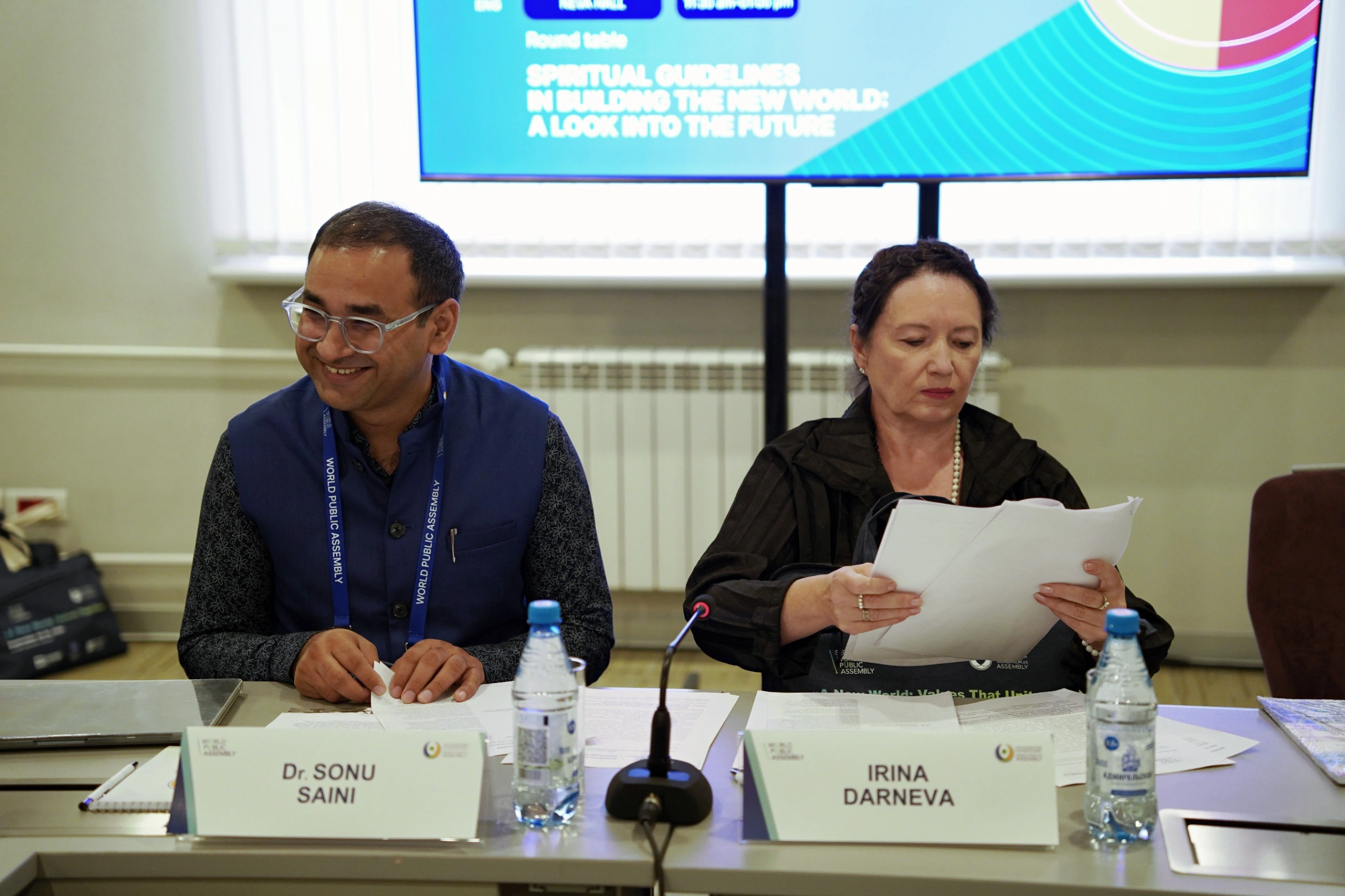
The meeting was moderated by Irina Darneva, Member of the Presidium of the World Forum of Spiritual Culture, Chairperson of the Council for Spiritual Culture and Member of the Supreme Advisory Council of the World Peoples Assembly and Sonu Saini, Chairman of the Union of Russian translators of India and Senior Lecturer at the Centre of Russian Studies at Jawaharlal Nehru University.
Opening the discussion, Irina Darneva emphasized that in today’s world there is a sharply growing need for sustainable moral foundations capable of ensuring harmony between the individual, society and nature. According to her, it is spiritual culture that forms a system of values common to all traditions: compassion, non-violence, justice and care for one’s neighbor. These principles become a universal language of intercultural trust, enabling people with different worldviews to find common ground and act together.
As the moderator noted, the purpose of the round table was to go beyond theoretical discussion, identify mechanisms of interaction that are already working, and summarize international experience, transforming spiritual values not merely into an instrument for preserving memory, but into a real foundation for sustainable, coordinated and humane development.
The round table began with a video address by Mary Pat Fisher, Manager of the International Interreligious Community Gobind Sadan and Member of the Council of Elders of the World Peoples Assembly. Addressing the participants, she conveyed the teaching of her Teacher, Babaji Virsa Singh:
- Humanity does not need new dogmas. All the prophets carried one message: to learn to be good people, so that the Earth may become the Kingdom of God.
The speaker stressed that these truths are extremely simple and resonate in the traditions of every people. In support of this, she cited Jesus Christ’s commandment «to love the Lord with all your heart, soul and mind» the key Jewish prayer «Shema Yisrael» which echoes it, and the eternal law of the Buddha: hatred does not cease by hatred, but only by love. Mary Pat Fisher expressed her conviction that sincerely following all these principles can fill the world with light and warmth even today, and concluded her address with words of blessing for everyone present.
In the business part of the discussion, Irina Darneva asked the speakers to address the key question: which universal spiritual and moral values could become a common foundation for people of different traditions and worldviews?
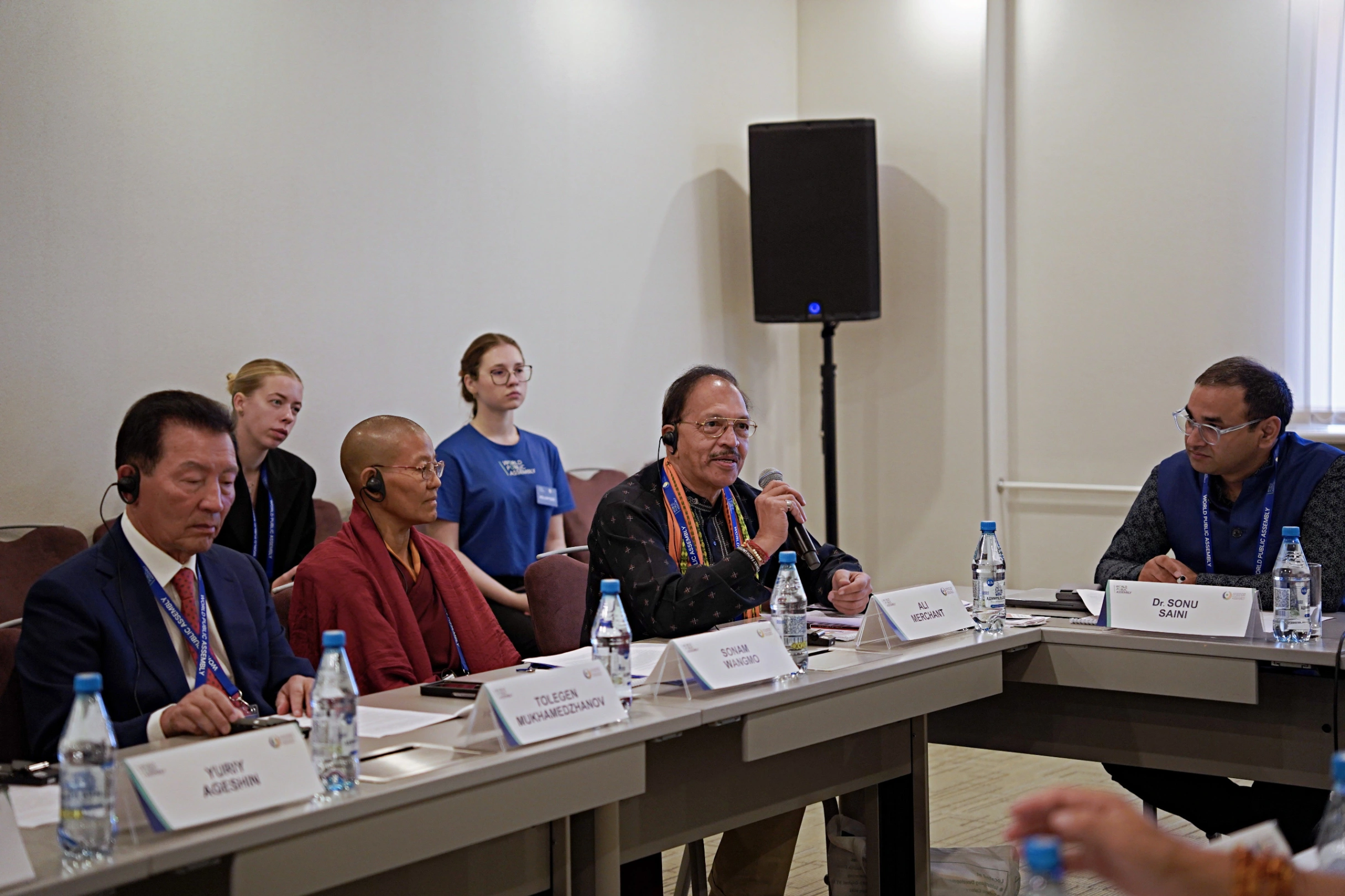
The first to deliver a report was Ali Kamruddin Merchant, Secretary General of the Temple of Understanding India Foundation. Expressing gratitude to Secretary General of the World Peoples Assembly Andrei Belyaninov and to the participants of the meeting, he noted that in a world that has changed radically today, institutions need to be renewed. In the speaker’s view, in drafting the final resolution of the round table, it would be appropriate to rely on the 12 principles of the United Nations; however, that organization has largely exhausted its potential and the planet needs a new authority capable of ensuring the security of borders without the use of armed force.
The expert called on those present not to succumb to pessimism and to remember that «the Earth is one country and humanity is oriented toward unity». At the same time, he made an important distinction: while relations between people should be built on love and mutual forgiveness, international relations require the rule of law.
- When a driver runs a red light, the police cannot forgive the violation of the rules; likewise, nations must comply with common legal norms, Ali Kamruddin Merchant concluded.
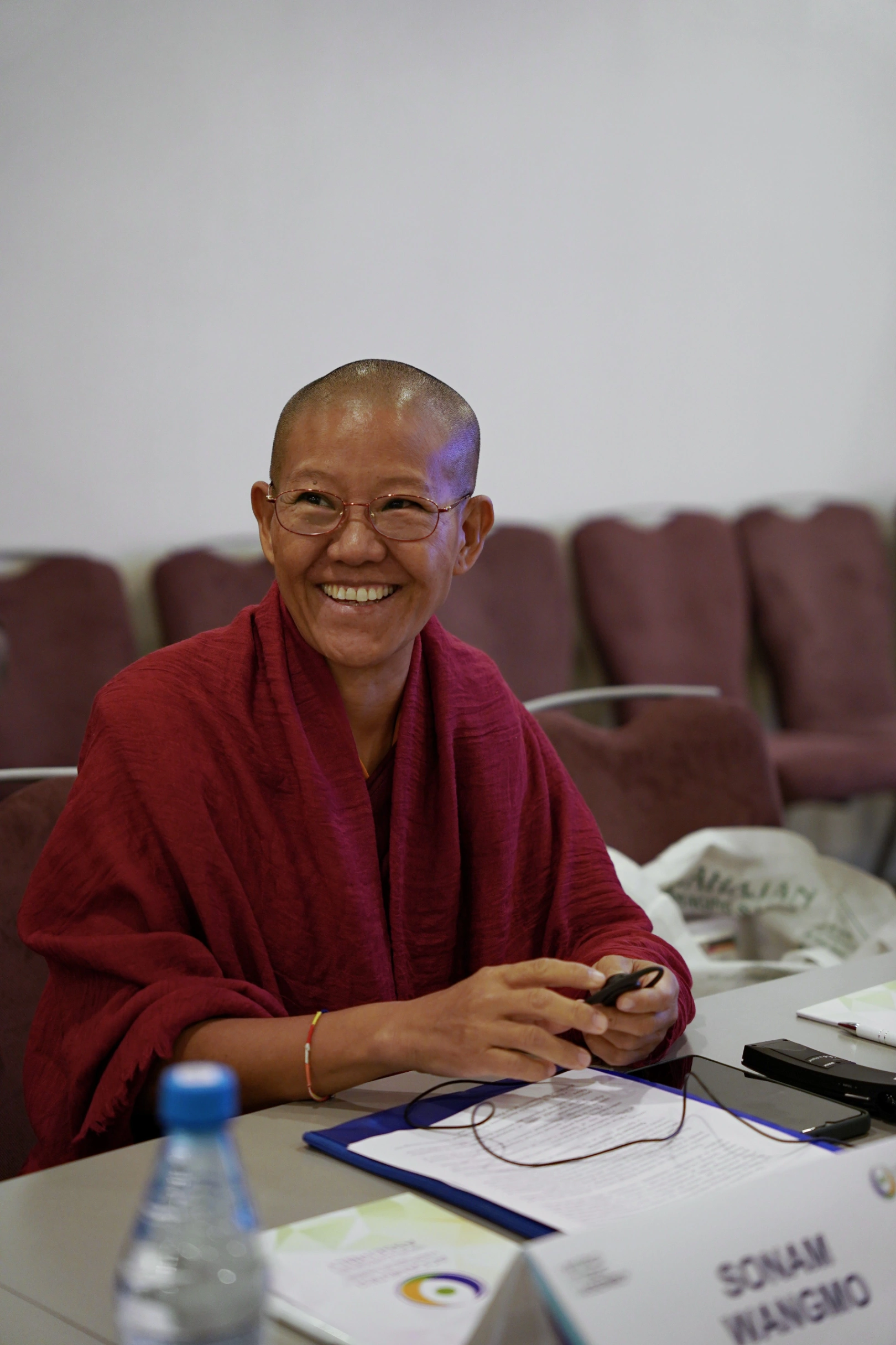
Sonam Wangmo, Director of Education at the Vajrayana Buddhist Council of Malaysia, a Buddhist nun, PhD, teacher and writer, began her address with a touching metaphor:
- Just as a mother protects her child, humanity must cultivate compassion. It can become our inner compass and reflect the central idea of building the world of tomorrow. Through compassion, we become involved in building peace in a genuinely peaceful way.
In the speaker’s view, today we are facing an environmental crisis, technological upheavals and social divisions, and humanity is compelled to rethink the foundations of a just and peaceful world order. At the same time, a spiritual principle becomes the main pillar of the new world order, and it is especially important here to turn to the traditions of Buddhism.
Sonam Wangmo paid particular attention to the role of education, which should be aimed at fostering ethical responsibility and resilience. In conclusion, she emphasized that compassion is not weakness, but a transformative foundation both for states and for intercultural dialogue – a force capable of uniting us all.
Yuri Ageshin, Vice-President of the organization «Peace through Culture», addressed the participants with words of encouragement. Drawing attention to the concern and tension visible on the faces of those present, the speaker recalled what matters most: the spirit that dwells in every heart must burn brightly and directly, and nothing can dim its ardent glow:
- All worries, shortcomings and the small details of life are secondary. What matters most is service to the light and the understanding that life is beautiful.
The discussion was continued by Tolegen Mukhamedjanov, President of the International Association «Peace through Culture». He began his address by honoring the memory of those who are no longer with us: his predecessor Wilhelm Augustat, and Iosif Kobzon, who did much for the movement of spiritual culture. The speaker particularly noted the courage of the great artist, who, despite a serious illness, delivered a report at the World Forum for Spiritual Culture in Astana in 2010.
- Life does not stand still; an idea lives and breathes in concrete people. God has dissolved into the hearts of billions of people, but He has not disappeared. Having found Him within oneself, a person is able to return Him to the whole world, the speaker shared.
Tolegen Mukhamedzhanov concluded his address with a musical performance of his own. According to him, in a world standing on the brink of large-scale cataclysms, it is music that makes it possible to express a personal attitude to what is happening and to convey the hope that one wants to share with like-minded people.
As part of the round table, a video address from colleagues in Europe was presented. On behalf of the International Association «Peace through Culture. Europe» the participants were greeted by Marco Vukovich, Vice-President of the Association and Member of the Supreme Advisory Council of the World Peoples Assembly. The expert emphasized that in today’s realities, all public structures must respond attentively to the challenges of the times and that moving forward is impossible without a solid ethical foundation. In support of this, he cited the thought of Nicholas Konstantinovich Roerich that «only through culture can humanity achieve peace»; only culture, humanism and eternal values unleash creative potential and unite the global community.
In Marco Vukovich’s conviction, the world needs not so much direct reforms as moral guidelines: mutual respect and the aspiration toward unity. In conclusion, the speaker expressed deep gratitude to the organizers for creating such a significant discussion platform.
Lama Yonten Jamtso, official representative of the Jonang Buddhist tradition in Russia, Buddhist master, expert in Kalachakra philosophy and spiritual leader of the Jonang Buddhist Centre, shared his view of the topic under discussion:
- Although the philosophies of different teachings have their differences, it is love and compassion that constitute the true foundation of every religion. In order to draw closer to one another, we all need to work constantly on improving our own morality.
According to the Lama, it is especially important to cultivate in people a sense of support, and here the mission of the younger generation is great. By setting an example for young people and supporting them, we help young people focus not on the material, but on genuine happiness. In conclusion, the speaker expressed his conviction that a world built on kind feelings is capable of developing the consciousness of every person and leading humanity to true harmony.
Nina Zaltsman, President of the Israeli Society of Living Ethics, addressed the participants of the round table with a video message. She noted that the land of Israel has witnessed not only wars, but also the emergence of great religions – from Abraham to Christ and Muhammad – and has absorbed the wisdom of the centuries. In support of this, the speaker cited the words of the sage Hillel, who, when asked about the essence of the Torah more than a hundred years before our era, replied: «What is hateful to you, do not do to your neighbor. This is the whole Torah. The rest is commentary.».
In Nina Zaltsman’s conviction, for the most part, our thoughts and feelings remain uneducated, while education is proper «nutrition»: what we read and who we communicate with. In this regard, the expert called the pages devoted to the study of living ethics the best instrument of such education:
- It is the energy of lofty, vivid, sometimes sharp thoughts addressed to science and parables. All of this awakens our consciousness and changes our lives. Hope, joy, freedom and responsibility awaken – things we want to share. In our evening prayers and meditations, we unite, aligning our hearts with love for the world. Thought is also action, and peace begins with a person, with the culture of their thoughts.
Svetozar Darnev, Chairman of the Audit Commission of the World Peoples Assembly and Chair of the Construction and Financial Association «Osnova», began his address with a reflection on how important it is to move from spirituality to matter. Describing himself primarily as a practitioner, he raised the question of the nature of trust and its opposite – deception – noting that, for «love» the counterweight is «fear».
- If trust is important, what does it mean in practice? To live honestly – and then it will benefit everyone. «Do not lie and do not steal» already sounds almost like a political slogan, the speaker stated.
Turning to Russian roots, Svetozar Darnev explored the theme of labour, usefulness and attitudes toward acquisitiveness through the teaching and life of Venerable Sergius of Radonezh, his personal example, the rule of the monastery he founded and his spiritual guidance. Sergius not only permitted labour, but also set an example himself by performing hard work: he built monastic cells, carried water, ground grain with hand millstones and sewed clothing.
- Labour, usefulness and non-acquisitiveness – these are the values that underlie life, principles that carry over into our real life: do not take more than you need for yourself and pass material goods on to people properly, so that they find life interesting, the expert summarized. In conclusion, he emphasized that any crisis is less severe where there is trust.
Natalia Toots, Member of the Union of Journalists of the USSR and Russia and Editor-in-Chief of the cultural and educational Delfis magazine, congratulated the participants of the round table on the fact that, by gathering together, they are doing good for the whole world. In the expert’s conviction, only the power of spiritual culture can overcome all the challenges of the present day.
This idea was developed by Vladimir Nadezhin, Honoured Artist of the Russian Federation and President of the Delfis Charitable Foundation. He noted that the key words of the round table were «spirit» and «matter» and that the discussion itself turned out to be extraordinarily informal, permeated with a spirit of unity, where every participant listened, spoke and complemented one another.
Khenpo Arta Lama Rinpoche, Lama of the Tibetan Bon tradition and Head of the Yungdrung Bon Centre, summarized the results of the meeting. He compared those gathered to one large family and expressed his confidence that it is precisely in this spirit of kinship and mutual understanding that the common cause should continue.
The round table was also attended by:
Sergey Klyuchnikov - Editor-in-Chief of Science and Religion magazine;
Madi Bolero Hamada - former Prime Minister and Acting President of the Union of the Comoros.
The main outcome of the meeting was the understanding that spiritual values must be realized not only in theory, but also in practice - through upbringing, education, art, scientific inquiry and service. The round table identified existing mechanisms of international cooperation and outlined long-term guidelines for a shared future. Its participants expressed their conviction that spiritual culture is not merely an instrument for preserving memory, but a real resource for moving forward, a foundation for the sustainability, harmony and humane development of humanity.
Additional information is available on the official website of the World Peoples Assembly, on its VKontakte and Telegram accounts, and at media@world-assembly.org.