


"No Social Institution Can Prescribe Happiness to a Person!": Personal and Cultural Indicators of Happiness were discussed in Moscow

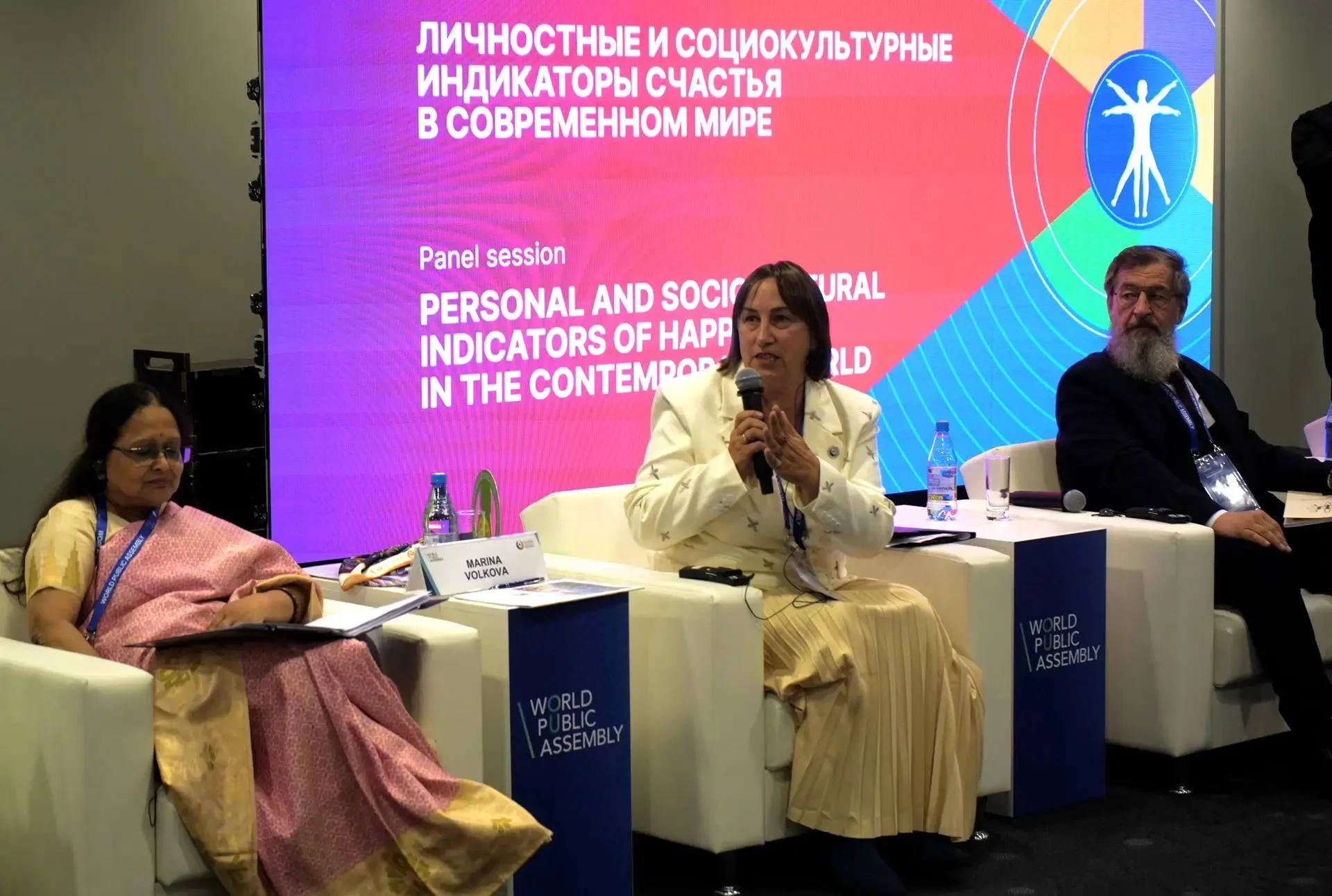

Panel session “Personal and Sociocultural Indicators of Happiness in the Modern World” was held on September 18, 2026, at the World Trade Center. The event is a part of the Second World Public Assembly “New World: Values That Unite,” which is taking place in Moscow from September 18 to 19.
Participants discussed happiness as one of the most important dimensions of human well-being, its connection to quality of life, and the conditions under which a person can develop, realize their potential, and feel a sense of belonging to society.
The discussion was attended by representatives from various countries and professional fields: cultural and artistic figures, scholars, entrepreneurs, and public figures from Russia, India, Brazil, Nigeria, Egypt, Syria, China, Tanzania, and other countries. The moderators were Marina Volkova, Head of the Department of Happiness of the World Peoples Assembly, and Savita Roy, Head of the Department at the University of Delhi, Director of Daulat Ram College at the University of Delhi, Professor, Doctor of Philosophy.
Co-founder and Executive Producer of Titânio Films Liliana Kawase reported that, according to the World Happiness Report, Brazil ranks 32nd out of 147 countries, exceeding the average — and this is despite high levels of crime, unemployment, and social inequality. Researchers call this phenomenon the paradox of happiness. The answer lies in two pillars: deep social connections and the ability to navigate difficulties with flexibility and humor.
— In Brazil, the boundary between family and friends is blurred. You are never left alone, whether in trouble or in joy. Brazilian happiness is not at all a commonplace stereotype, but a deeply rooted part of culture, — shared Liliana Kawase.
In her conviction, the world should learn from Brazil the key understanding: happiness is not a life without problems, but the art of remaining resilient. The speaker recalled a Brazilian saying: “Rir para não chorar” — “To laugh so as not to cry” — which expresses a refusal to let troubles break one’s spirit. And to the question about the secrets of a joyful childhood, she answered: even a not-wealthy family can raise a happy child if there are loving loved ones nearby and a society ready to support them.
Co-founder of the “Development and Cooperation for Africa” initiative and specialist at the Roscongress Foundation David Otujor Okpatuma drew attention to the fact that society’s progress becomes truly meaningful when people recognize it in their own lives. A growing economy and infrastructure are important, but the main question is different: can a person live with dignity, trust those around them, develop their abilities, and feel that their presence changes something. The speaker noted that measuring happiness requires different types of data: assessments of life as a whole, everyday emotions, and a sense of meaning.
— No social institution can prescribe happiness to a person. But institutions are capable of creating conditions in which people have more freedom to build the life they want and value. Let us judge development by the opportunities it opens, by the connections it strengthens, and by the dignity it protects, — urged David Okpatuma.
The discussion was also attended by:
Alexandra Ochirova — Co-Chair of the Supreme Advisory Council of the World Peoples Assembly, UNESCO Goodwill Ambassador, member of the Commission of the Russian Federation for UNESCO, Doctor of Philosophy, member of the Writers’ Union of the Russian Federation, academician of the Russian Academy of Arts;
Rim Fuad Abdul Ghani — architect, researcher of architectural heritage, writer, consultant on heritage, culture, and community development, founder and head of the Tarim Center for Architecture and Heritage in Damascus;
Oleg Artemyev — pilot-cosmonaut of the Russian Federation, Hero of the Russian Federation, Deputy of the Moscow City Duma;
Tatyana Sizova — Commissioner for the Protection of the Rights of Entrepreneurs in Moscow, Chair of the Supervisory Board of the Association of Entrepreneurs “Business Assembly,” Chair of the Supervisory Board of the Association of Intellectual Volunteers, member of the Association of Russian-Speaking Coaches;
Vladimir Andreev — systems architect, president of an IT company, psychologist, head of the informal association “Happiness Laboratory,” author of the “Gamification of Life” methodology, author of the book “A Model for Quantitatively Assessing the Level of Happiness”;
Michael J. Padilla Pagan Paiano — professor, CEO of the international law firm Horizon Management Company;
Elena Padilla Pagan Paiano — Deputy CEO of the international law firm Horizon Management Company.
The discussion participants agreed that the modern understanding of social development increasingly goes beyond purely economic indicators. Along with material well-being, public trust, access to education and culture, opportunities for self-realization, and a sense of belonging to a community are acquiring ever greater importance.
Based on the results of the session, the experts identified key areas for further work: developing education, supporting public initiatives, creating urban and institutional conditions for human well-being, and also finding approaches to measuring happiness that consider both the guidelines common to all people and the cultural diversity of the peoples of the world.
Additional information — on the official website of the World Peoples Assembly and at media@world-assembly.org.