


The Role of a Happy Family in the Global Prosperity. A Round Table Discussion at Daulat Ram College in New Delhi
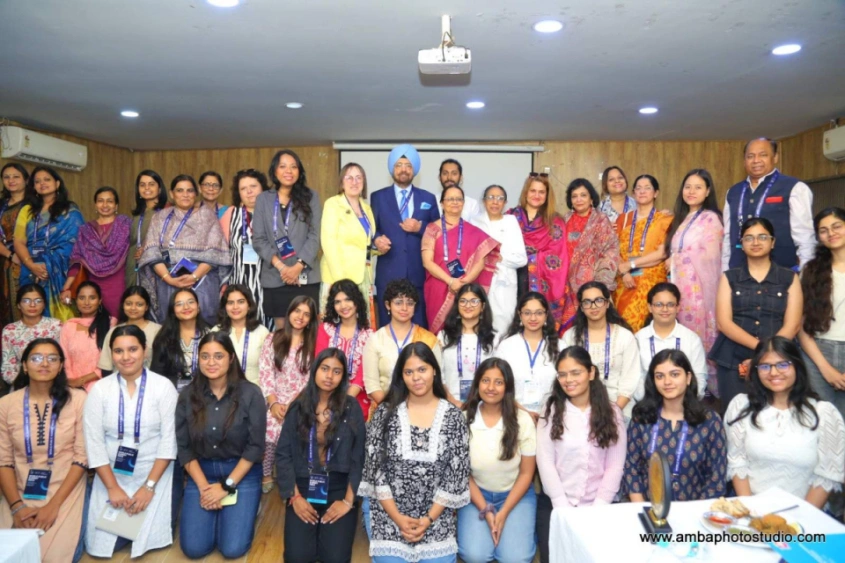
The International Round Table "Building a Harmonious Future for Humanity: The Role of a Happy Family in the Global Prosperity" was held on March 24, 2026, at Daulat Ram College at the University of Delhi. The focus of the discussion was on the family as an integral part of individual and societal happiness. The event was held as part of the World Public Summit: India "New World: India in the Architecture of a Shared Future". It brought together delegates from Malaysia, Russia, and India, as well as faculty members from the University of Delhi and the College.
The main topics of the roundtable were:
issues of the family, its role in shaping a healthy society,
the role of women in the well-being of society and the economy,
the application of the concept of happiness to solving regional and global problems, and
the diplomacy of happiness as an effective tool for bringing nations closer together.
The event opened with the lighting of the inaugural lamp ceremony, a traditional rite symbolizing the triumph of light over darkness and knowledge over ignorance.
The Director of the College, Head of the Department at the University of Delhi, Professor Savita Roy, delivered a welcoming speech to the audience.
The Secretary General of the World Peoples Assembly, Andrey Belyaninov, also greeted the participants:
– We will be discussing the values that make our lives meaningful and joyful, and family as the most important of them. We will explore the practices of well-being that contribute to the harmonious development of each individual and humanity as a whole.
In her opening remarks, Marina Volkova, Head of the Department of Happiness at the World Peoples Assembly, emphasized the significance of happiness in the lives of individuals, nations, and the world, and the need to promote and practice happiness.
The discussion identified the main challenges of our time: the disconnection between family members, particularly between different generations, the disconnection of young people in general, the digital divide that exists in real life, and the lack of face-to-face communication.
The founder of the Fearless Foundation from Malaysia, Nurul Shamsuri, spoke about her large family and the women's issue: a healthy society cannot exist without protecting women's rights.
Sergey Korchagin, Director of the Center for Modern Technologies of Transformation and Scientific Organization of Labor "Trajectory of Change," voiced the key idea of the roundtable: "A harmonious society cannot exist without a happy family, which is its foundation."
– Teaching young people practical skills in managing the economy of happiness should be based on a solid foundation of universal spiritual and moral values, - he added.
Renu Gulati, Professor at the Department of Child and Human Development at the University of Delhi, a UNICEF specialist in child development, and a member of the Executive Committee of the Buniyadi Sankaar Foundation, which implements projects for young people, drew the audience's attention to the role of the family in preserving culture and traditions.
– We live in large families, and grandparents pass on their experiences to the younger generation. However, there is a trend towards smaller families, and small families are not effective in transmitting cultural values.
Renu Gulati also emphasized that “parents play a crucial role in raising children and young people”. Dalbir Singh, Chairman of the One Globe Forum, President of the Foundation for Policy and Governance, President of the Parliamentary Health Forum, and one of the co-founders of the World Peoples Assembly, agreed with her. He said, "A mother is very important in a family. We learn ethics from our mothers." He also emphasized, "If we want to be happy, we need to address the challenges of digitalization, migration, and competition. The United Nations already has programs focused on happiness." It is important that people strive for happiness and recognize its value.
Many speakers spoke about the importance of preserving their culture, even when they are away from their homeland. Renu Gulati remarked,
– It is important not to lose our culture. Even when children leave, they take their culture with them.
In this light, cultural exchanges, such as this roundtable and the World Public Summit platform as a whole, are particularly important. This was unanimously agreed upon by all those present.
A laughter therapist and a trainer in joy and happiness, Mitya Efimov, the Ambassador of Laughter Yoga in Russia, spoke to the Summit participants in another international language – the language of laughter.
– If we don’t laugh and smile, where will the happiness come from? – he explained.
– This dialogue between different cultures and different languages was intended to show all those who participated that we are much closer to each other than we sometimes seem to be, and that our happiness lies in our unity, our respect for our traditions and culture, and our care for our families and our children, - concluded Marina Volkova at the end of the roundtable.
The World Peoples Assembly is an international union of non-governmental organizations that forms a humanitarian platform for cooperation between the peoples of the world based on trust, mutual respect and common values.
Media accreditation for the Summit, cooperation issues: media@world-assembly.org, +7 (985) 768-2053 (Oksana Leontieva).
More information is on the official website of the World Public Summit.