

The International Media Club of the World Peoples Assembly discussed Trust in the Media, Digital Transformation and Fact-Checking in Brazil
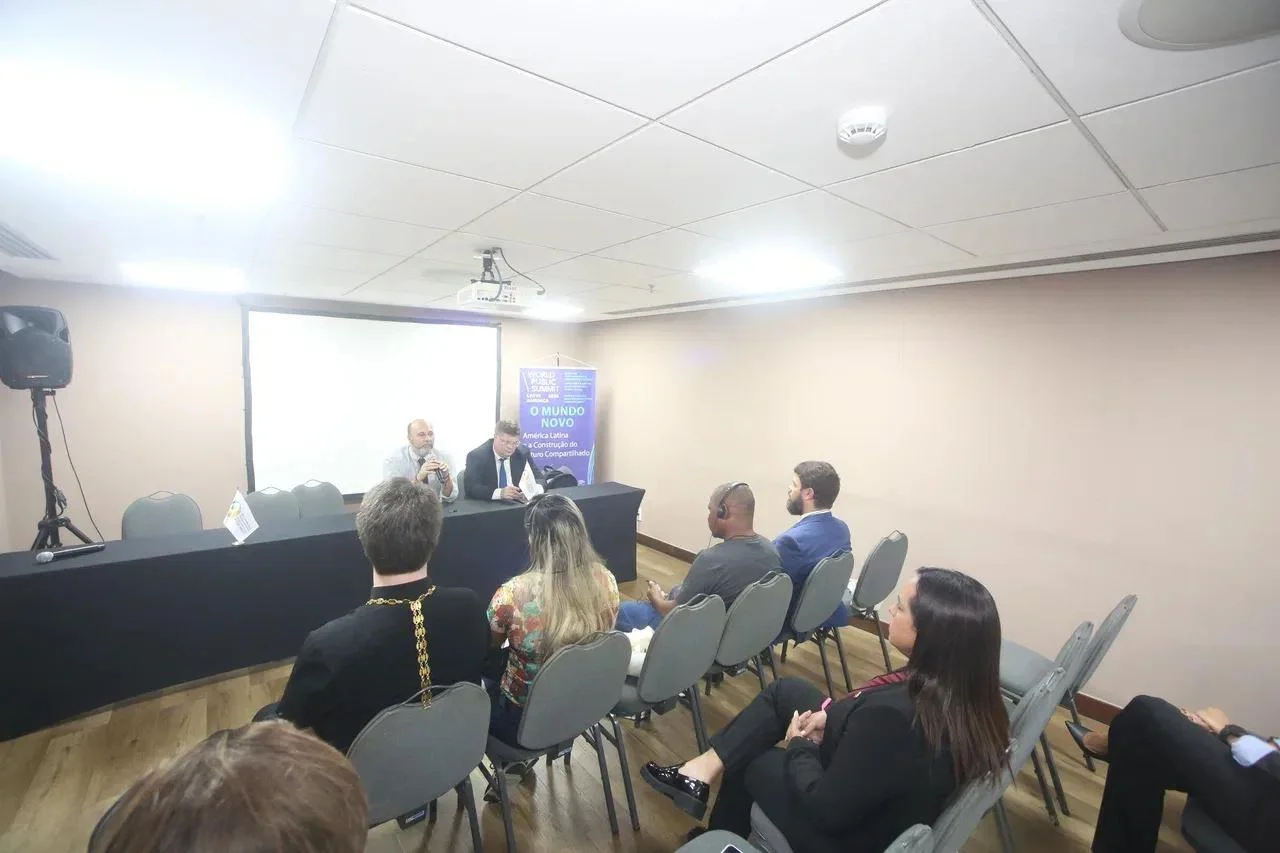
On June 16, 2026, Salvador (Brazil) hosted the meeting of the International Media Club of the World Peoples Assembly "Trust in the Media, Digital Transformation and Fact-Checking: Trends and Challenges for the Media of the 21st Century". The event was held as part of the World Public Summit: Latin America "New World: Latin America in Shaping a Shared Future" and brought together representatives of national and international media, experts in the field of media and culture, representatives of scientific and educational institutions, intergovernmental and non-governmental organizations, government authorities from different countries.
The discussion was moderated by Nikita Anisimov, an international journalist, member of the Civic Chamber of the Russian Federation, Adviser to the Secretary General of the World Peoples Assembly.
The speakers included:
Evgeny Safronov - Head of the Media Center of the World Peoples Assembly, founder of the InterMedia News Agency, journalist, analyst, expert in culture and entertainment industry, academician of the Academy of Russian Music (Russia, online);
Patricio Mary Bell – journalist, writer (Chile);
Sergey Lukyanenko – writer, screenwriter (Russia, online);
Ernesto Walter Heredia Martinez – Ambassador of the BRICS International Municipal Forum (MMF BRICS) for Peru and Advisor to the Senator (Peru);
Silvana Yarmolyuk – Head of the CSRC of Argentina, film director (Argentina, online);
Adriana Vieira – TV journalist, media manager (Brazil);
Gabriella Pena– Member of the Venezuelan Parliament (Venezuela);
Fidel Antonio Castro-Smirnov – Academician of the Cuban Academy of Sciences, Professor at the University of Havana (Cuba);
Pablo Sepulveda Allende - doctor, coordinator of the Venezuelan direction in the Network for the Protection of Humanity, grandson of Chilean politician Salvador Allende, blogger (Venezuela)
and numerous representatives of the Latin American media.
The main topics for discussion were:
Digital transformation and its impact on media consumption;
Crisis of trust in traditional media, spread of disinformation and fake news;
Media globalization;
Freedom of speech and media pluralism;
Equal interaction in the digital space and the establishment of new rules in the media sphere.
Evgeny Safronov opened the meeting.:
– Literally over the past year, neural networks, which we mistakenly call artificial intelligence, have penetrated the work of the media on a wide front, radically changing the information landscape and saturating it with a mass of accidental and intentional errors. Now the reliability of every word in the media is coming to the fore, and such an assessment is almost impossible to carry out alone, even for the largest publications. The solution is systematic cooperation based on common standards, despite geographical and cultural differences.
The speech aroused strong support among experts – Patricio Mary Bell spoke, in particular, about the prevalence of fakes about Russia in recent years, and Nikita Anisimov – about the need to observe journalistic ethics, and suggested combating false information through cooperation between the media of different countries, in particular, Russia and Latin America.
Pablo Sepulveda Allende spoke about his work as a blogger and noted that even with a small audience, it is necessary to be responsible for the information posted. Gabriella Pena supported this position, noting:
– The information field in the modern world is very saturated, and the responsibility of those who form it is enormous. A word can hurt or kill. It is very important that everything that enters the information field is meaningful. I would like to draw your attention to the fact that it is important to talk not only about the negative, but also about the positive aspects in the life of society, to create a space for a positive agenda. Let's do our best to ensure that positive news unites us and our continents!
Silvana Yarmolyuk spoke about her media projects on radio and Telegram, telling about Russia for a Spanish–speaking audience, and noted that the key problem for all modern media is the reliability of information.
– Today, the main task for modern journalists, analysts, political scientists, and bloggers is not the speed of news distribution, but their reliability. Clickbait and fake news must become a thing of the past, and most importantly, we must not compromise media freedom. The next important challenge we face is the preservation of cultural identity in global media. Globalization should not imply complete uniformity. It is necessary to create content in local languages, to broadcast local values, and not just duplicate Western narratives. And another serious challenge is a direct dialogue with the audience, without intermediaries. The formats of press services are no longer functional when it is important to establish communication with people, and if we lose contact, we lose trust forever. Finally, the final challenge facing modern media is the issue of financing. How to solve this problem so as not to depend on corporations? It is necessary to develop crowdfunding and cooperatives. Only those who pay for their own microphone are independent.
Sergey Lukyanenko noted the increasing role of public diplomacy in the modern world
– If we maintain a constant exchange of thoughts and feelings between people, countries, peoples and cultures, it will certainly contribute to the fact that traditional diplomacy will be able to do its job much more effectively. We are building bridges that are not based on paper contracts or strict texts of memoranda. They are based on artistic texts, canvases, murals, musical works, and people who are gradually becoming interested in the culture of another country, another tradition, and a different outlook on life. This helps us understand more than anything else that most people have almost the same interests. We all believe in a bright future, and we want this future to be peaceful, filled with mutual understanding and allowing us to see each other face to face, cross all the distances between us, and meet at the same table. In my mind, I'm at the same table with you too. And I would very much like to hope that each of the participants in today's Summit will make a tiny but very important drop of their personal contribution to the mighty common stream that will bring peoples closer together and help peace throughout the world.
The writer's speech turned out to be extremely inspiring and met with a strong response from all participants of the meeting.
The event confirmed the acute relevance of all the issues raised during the discussion. The next meeting of the international Media Club of the World Peoples Assembly will be held in July 2026 in Addis Ababa (Ethiopia).
Media information and cooperation issues: media@world-assembly.org.
More information about the regional summits of the World Peoples Assembly is on the official website of the World Public Summit.