

 Back to news
“A Common Enemy Unites, but Only a Common Goal Preserves”. Reviving the “Spirit of the Elbe” to Save International Trust has been proposed in Moscow
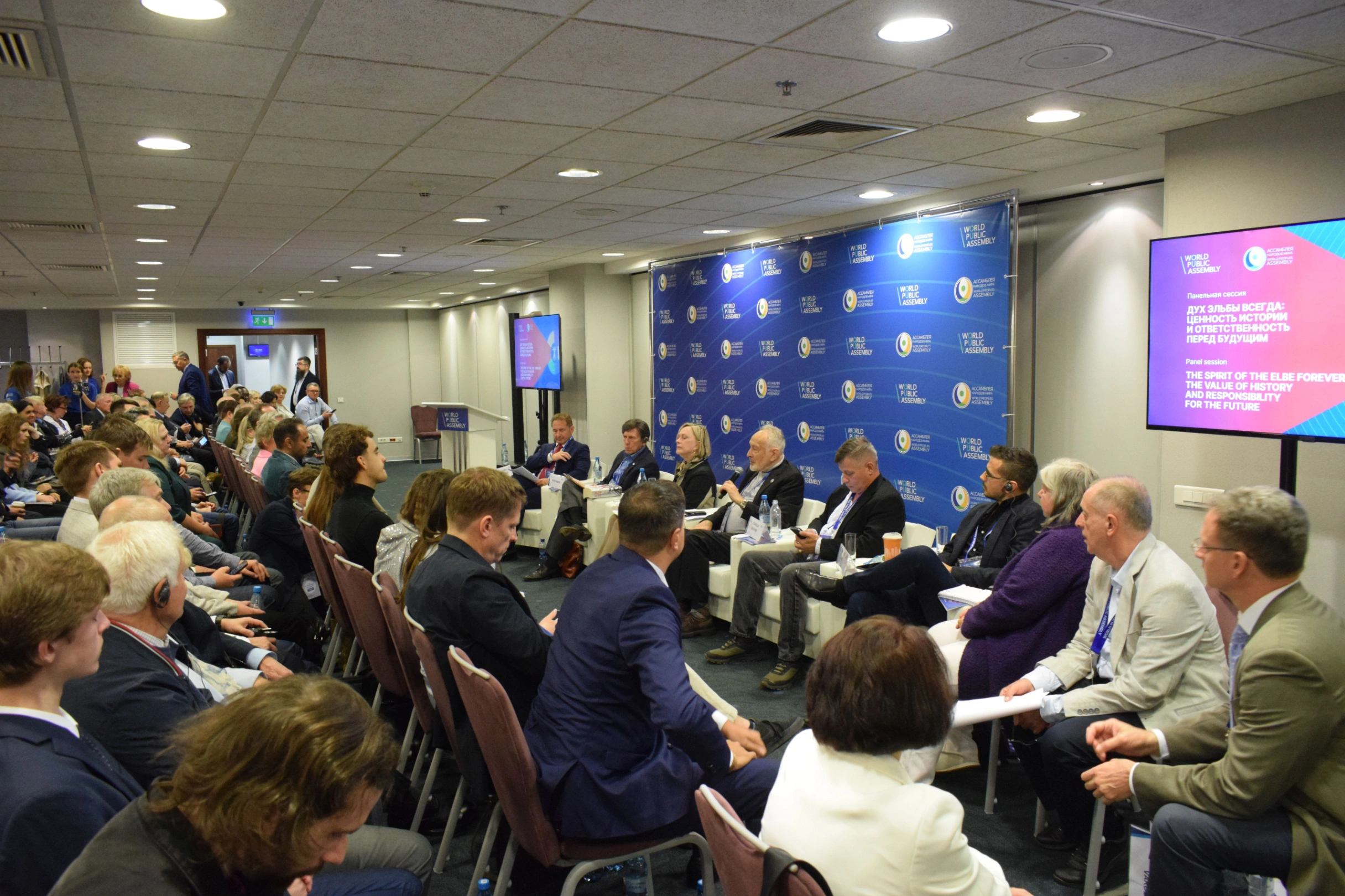
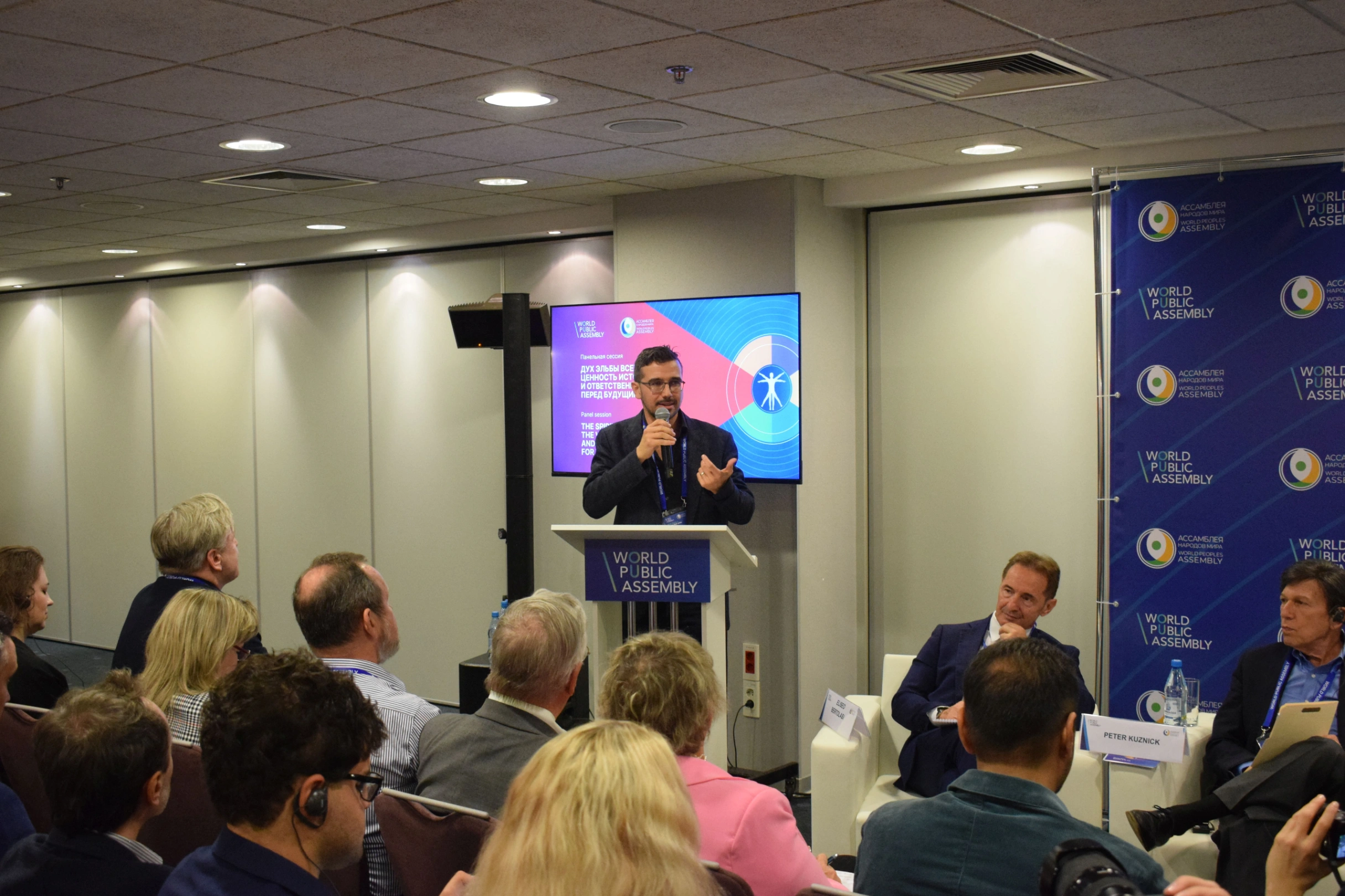
The Panel Session “The Spirit of the Elbe Forever: The Value of History and Responsibility for the Future” was held on September 18, 2026, at the World Trade Center. The event was part of the Second World Public Assembly “New World: Values That Unite” held in Moscow from September 18 to 19.
The session participants discussed how the “Spirit of the Elbe”- the legacy of the 1945 meeting, based on trust, friendship and cooperation – can be revived in the present-day reality; how to counter the distortion of the history of the Second World War; and what public, educational and humanitarian initiatives can help restore international dialogue.
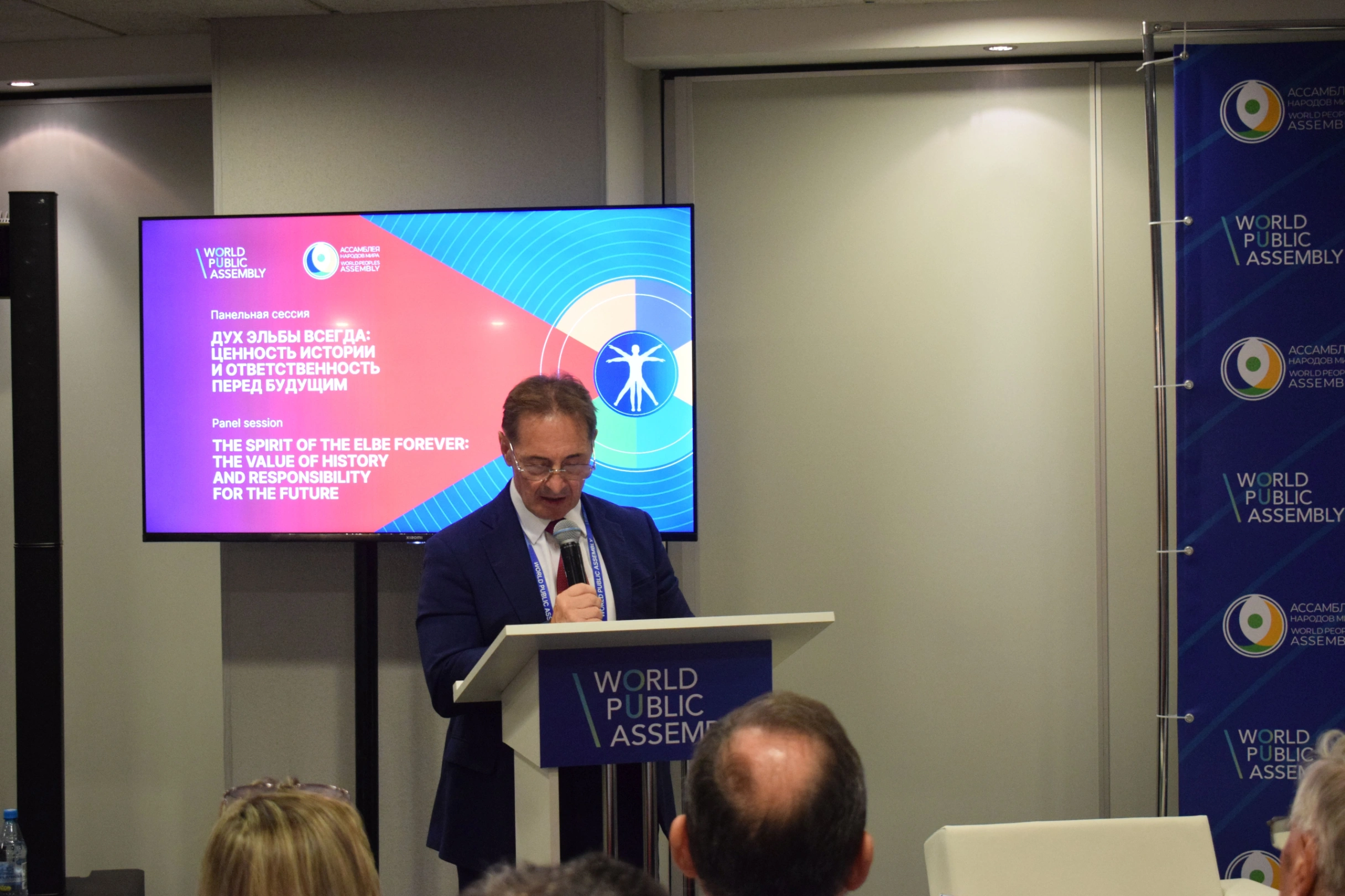
The session was moderated by Elena Branson, Chairperson of the American Club in Moscow; Valery Ruzin, Deputy Secretary General of the World Peoples Assembly, addressed the participants with welcoming speech.
Experts and public figures from the United States, Canada, Italy, Germany, Israel and Russia took part in the session: Peter Kuznick, Ute Kollies, Eliseo Bertolasi, Matthew Ehret, John Varoli, Stanislav Krapivnik, Grigory Pelman, Inna Darmstadter, Alexey Semenov and Caleb Maupin. The central topic of the discussion was the meeting of American and Soviet troops on the Elbe on April 25, 1945, as a symbol of the fact that even at the height of a war, despite ideological differences, the Allies are able to unite for a common goal. The participants spoke about the fragility of peace and the fact that historical memory is increasingly becoming a hostage to the political conjuncture.
The following initiatives were announced and presented at the session:
Organizing a Global Leaders Summit: Initiating of a high-level meeting to comprehensively discuss global security issues, strengthen peace and advance the nuclear disarmament agenda (Organize a Global Leaders Summit to Address the Questions of Peace and Nuclear Disarmament).
Development of global educational systems: Creation and implementation of international educational programs aimed at fostering a culture of peaceful coexistence, empathy and the preservation of human life.
Launch of the global initiative “+10 Seconds”: The implementation of a large-scale project to prevent the nuclear threat, aimed at symbolically and mathematically changing the trajectory of the Doomsday Clock and moving it 10 seconds away from the point of global catastrophe and the self-destruction of Humanity.
Establishment of the Council for Peace and the Shared Future of Humanity: Creation of an international coordinating body (working platform) to ensure the sustainable, safe and harmonious development of human civilization based on the principles of equality and trust.
Particular attention was paid to the joint statement issued by the Presidents of Russia and the United States, Vladimir Putin and Donald Trump, on the 75th anniversary of the meeting on the Elbe in 2020, which emphasized: “The “Spirit of the Elbe” is an example of how our countries can put aside differences, build trust and cooperate in pursuit of a greater cause”.
Opening the discussion, Elena Branson emphasized:
– Today, trust and dialogue between countries are under threat, while historical memory is increasingly becoming a hostage to the political conjuncture. Our task is not simply to recall the past, but to find a foundation in it for a shared and secure future.
Peter Kuznick, Professor of History at American University in Washington, Director and Founder of the Nuclear Studies Institute, Oliver Stone’s co-author on the documentary series and book “The Untold History of the United States”, recalled the decisive role of the Red Army in the defeat of Nazism and the price of Victory – the 27 million Soviet citizens who died. According to him, while in 1945 the majority of Europeans recognized that the Soviet Union had played the leading role in the victory over Nazism, these views have changed substantially today.
– The meeting of American and Soviet troops in April 1945 was a triumphant, great moment of hope. It deserves to be commemorated and celebrated, – the speaker stated.
Ute Kollies, a retired United Nations diplomat and former Head of Office for the Coordination of Humanitarian Affairs field offices, worked in conflict zones in Africa for more than 20 years and took part in peace negotiations on Mali. She devoted her speech to education as a tool for peacebuilding. Referring to Spinoza’s words that peace is not the absence of war, but virtue and a state of mind, she called for teaching young people nonviolent conflict resolution, critical thinking and empathy.
– Negotiations and diplomacy are impossible without educating our children and young people. We must work actively to prevent war and know how to resolve conflicts without violence. This is the task of education, – Ute Kollies noted.
Eliseo Bertolasi, Candidate of Anthropological Sciences, journalist, public figure, Knight of the Order of Friendship, drew a parallel between the “Spirit of the Elbe” and the signing of the agreement establishing the Russia-NATO Council at the Italian Pratica di Mare airbase in 2002. According to him, that agreement was based on mutual trust, friendship and respect, whereas today their shortage leads the West and Russia along a dangerous path of escalation.
– Can a dialogue take place without trust and respect? No. Mutual trust is born of mutual respect. And I would like to emphasize this particular word – respect”, – Eliseo Bertolasi said.
The experts reached a common conclusion: the lessons of the past are not an archive but an effective tool. Unity is attainable, but it requires constant effort; a common enemy may unite, but only a common goal can preserve unity. Education, culture and public diplomacy can restore trust in relations between countries. At the end of the session, an initiative was put forward to establish the global “Spirit of the Elbe” movement – a permanent platform for uniting constructive forces, developing public diplomacy and countering attempts to falsify history. The participants unanimously supported the proposal, viewing it as an important step toward restoring trust between states.
The discussion at the session clearly demonstrated that civil society around the world is rapidly developing a conscious desire to take an active part in protecting Peace and saving Humanity from the threat of self-destruction. This profound association of like-minded people who share common values and are moving toward a common goal represents a genuine, living movement that can rightfully be called the international Peace movement “The Spirit of the Elbe.” The participants of the session noted that community based on the principles of the “Spirit of the Elbe” could become a decisive step toward restoring trust lost between countries and peoples.
Additional information is available on the official website of the World Peoples Assembly and at media@world-assembly.org.