

Alexey Pushkov on European Leaders: "They Act as If the Threat of Nuclear War Does Not Exist"
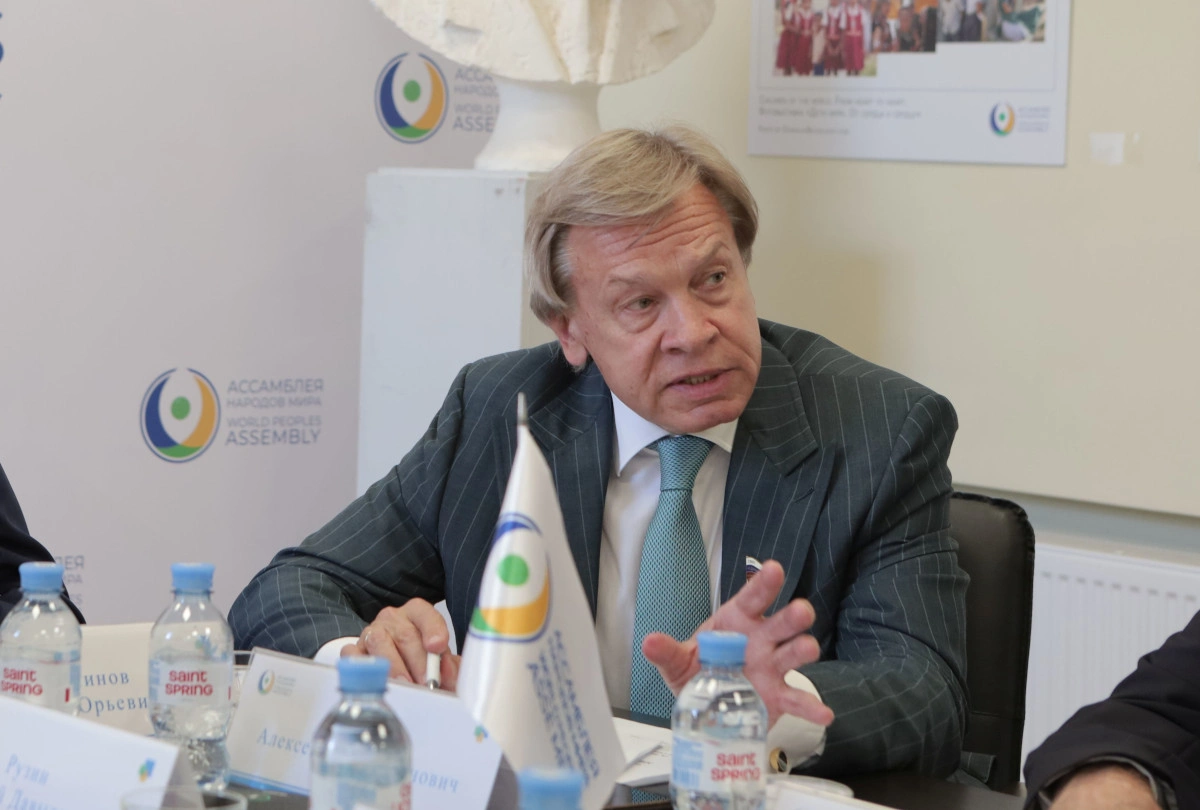
Aleksey Pushkov, Russian senator, Chairman of the Federation Council Committee on Information Policy and Media Relations, and international analyst, delivered a speech at the forum "Charles de Gaulle and the Spirit of Dialogue," held at the headquarters of the World Peoples Assembly on June 30, 2026.
From his very first words, the speaker reminded those present that General Charles de Gaulle's visit to Moscow was a consequence of the realization of the world's vulnerability after the Cuban Missile Crisis and the desire to ease international tensions.
- At that time, the first to meet with the Soviet leadership to prevent a new world war were Charles de Gaulle and Willy Brandt. Today we are witnessing a paradox: a direct military clash between Russia and the United States seems unlikely, yet it is the European capitals that are becoming the main instigators of war, - the politician noted.
In his words, "if the leaders of the de Gaulle era were building a Europe that was supposed to prevent a world war, today's leaders are building a Europe that is supposed to start one." At the same time, Alexey Pushkov drew attention to the fact that while in the past European politicians sought ways to ease tensions, today the first to meet with Vladimir Putin in a time of crisis is US President Donald Trump.
As an example of the changing nature of Europe, the senator cited recent statements by EU Defense Commissioner Andrius Kubilius about creating "NATO 3.0," a unified European military command, and an arms market with the aim of achieving full autonomy from the United States. The politician called the idea of complete independence from Washington utopian, but stressed that the very intentions of the European elite indicate a dangerous shift toward militarization and expansion.
In his speech, Alexey Pushkov paid special attention to Europe's loss of fear of nuclear weapons.
- In the 1980s, Europe had a powerful anti‑nuclear movement and the concept of "nuclear winter," developed jointly by Soviet and American scientists. Today, many have forgotten about this and act as if the threat of nuclear war does not exist, - he stated.
Alexey Pushkov criticized current European leaders, calling them "intellectually inferior" compared to the politicians of the de Gaulle era. Mentioning figures such as Keir Starmer, Emmanuel Macron, and Friedrich Merz, the speaker said that today's leaders rely on large financial‑military capital and the indifference of their own citizens. In his opinion, the Europeans' retreat into "niche zones" of protecting their own interests has led to the globalist elite acting in isolation from the real needs of the population and without any accountability.
Concluding his thought, the politician declared:
- The success of the European Union gave its leadership a sense of self‑admiration and a conviction in their own exceptionalism.
This, according to the speaker, is what is pushing the EU toward a military conflict over Ukraine – a country that is neither a member of the EU nor NATO and has no historical connection to them.
He also mentioned the rhetoric of the President of the European Commission about "our values" and the need to inflict a "strategic defeat" on Russia, calling it a tragedy of modern Europe.
In conclusion, Alexey Pushkov particularly thanked the World Peoples Assembly for developing public diplomacy in the face of the short‑sighted policies of a number of countries and emphasized that Charles de Gaulle's legacy remains a benchmark of responsible leadership. A special symbol of the continuity of historical memory, in the speaker's opinion, was the presence at the forum of the grandson of the great French leader – public figure Pierre de Gaulle.
- The current cohort of European leaders is unable to fully comprehend either the real state of affairs on the continent or the full gravity of the consequences of their actions. Pierre de Gaulle and his grandfather are the absolute opposite of those negative examples of political leadership we see in Europe today. This prompts us to give even more credit to true leaders, — the senator concluded.