

Coffee Diplomacy and Direct Import Policy: Integration of the Global Coffee Market Discussed in Moscow
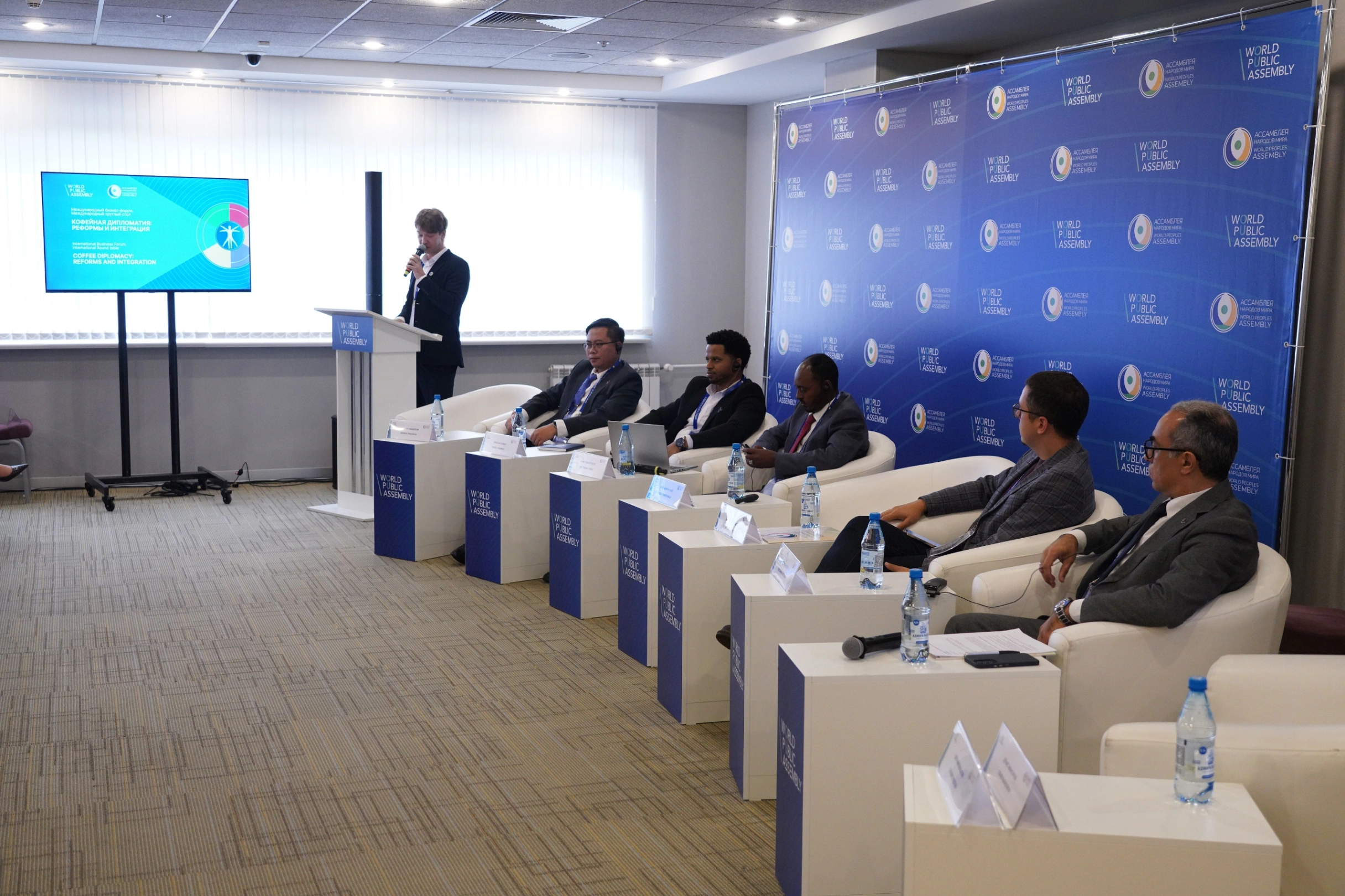
The international Round Table "Coffee Diplomacy: Reforms and Integration" was held within the Second World Public Assembly "New World: Values that Unite", held in mid-September in Moscow. The event was organized by the World Peoples Assembly and the International Alliance of Producers of Green and Roasted Coffee "Vert Alliance".
International experts from Laos, Ethiopia, Tunisia and Russia discussed the key challenges of the industry: building effective cooperation between producing and consuming countries, changing the culture of coffee consumption, as well as the role of international exhibitions in promoting national brands.
The participants of the round table were:
Dmitry Yelatantsev - moderator of the discussion, co-founder of Vert Alliance, member of the Council on International Economics of the World Peoples Assembly;
Alexander Motuzov - Coffee fermentation and quality expert, Development Director of Vert Alliance, Founder and CEO of coffee roasting company Eastbrew (Russia);
Denis Mansurov - Co–founder of Ingresso Coffee Company (Russia);
Hichem Eloumi - Secretary General of the Sfax Chamber of Commerce and Industry (Tunis);
Eyasu Adamtiye Wale - CEO of the foreign trade company Kumneger Trading PLC (Ethiopia);
Phoxai Phomke - the CEO of AP&P Agricultural Development and Trading Import-Export Sole Co. (Laos);
Alexander Mitinev - Managing Partner of Nilonian Coffee & Tea Coffee Processing Station, online -
and others.
Opening the discussion, Dmitry Yelatantsev outlined the main problem facing the Russian coffee industry - the lack of trust and direct communication:
- Russia is one of the top 10 coffee importing countries. However, until 2024, up to 60% of imports came from European countries. For decades, we have been buying coffee through the European Union without building our own infrastructure in the countries where it grows. Consuming huge amounts, we could not communicate directly with manufacturers.
Dmitry Yelatantsev noted that the Russian coffee market is actively developing. Today, about 1.5 kilograms of coffee per capita are consumed in our country, while in the EU countries this figure reaches 12 kilograms. Such a noticeable difference, according to the speaker, indicates an obvious growth potential.
He also stressed that producers often do not know the Russian market, and Russian companies do not have direct contact with farmers. To solve this problem, Vert Alliance is implementing a training system for partners from coffee-growing countries so that they understand the taste preferences and pricing policies of Russian consumers.
In confirmation of what was said, Dmitry Elatantsev recalled a curious but illustrative case, how in 2025 the Laotian partners brought 15 different lots of coffee to Russia, and one of the varieties delighted the roasters. However, it was not possible to order it due to the small volume of raw materials (only 500 kilograms). This example clearly demonstrates the importance of understanding the Russian audience for crop planning.
Phoxai Phomke shared ambitious plans to create a "trading hub" for Russian buyers.
- We want to organize transparent supplies of coffee beans to Russia and develop small Lao coffee shops in Moscow, - the speaker said.
The topic of innovation was revealed by Alexander Motuzov, who recently returned from Burundi. He shared his experience of using various technologies (yeast and lactobacilli) to ferment coffee berries, which makes it possible to create scarce products with a unique flavor bouquet.
- Thanks to fermentation, you get a unique product, the demand for which is growing regularly. Any target consumer can get their target coffee, - emphasized Alexander Motuzov.
However, the speaker also noted the disadvantages of the industry: the best coffee from remote villages is often lost in the general regional lots, without bringing additional value to the farmers themselves.
The cultural code of coffee became the leitmotif of Hichem Elumi's speech. The expert noted that partnership is impossible without understanding local traditions. Eyasu Adamtiye Wale reminded the audience that for his country, coffee is not just a source of income, but a real sacred ritual.
- In our language, the concept of "let's have coffee" means the beginning of any important conversation. We have three stages of the ritual: if we have not resolved the issue over the first cup, we pour the second, but when the third is drunk, it means that the interlocutors have agreed. We are ready not only to supply the best coffee to Russia, but also to organize fermentation processes for any task, - said Eyasu Adamtiye Wale.
Russian business has also outlined its development vectors. Denis Mansurov noted that the Ural capital sets trends for bright and liquid coffee.
- Yekaterinburg is considered one of the leaders in coffee consumption. We choose the coffee according to taste, and then we discuss the price. The trend now is to take expensive coffee and make a special blend out of it. But we critically lack supply stability. We would like to have a coffee hub in the city where we could store green coffee, ensuring business continuity, - the entrepreneur concluded.
The participants of the round table unanimously agreed that the traditional trading model should be replaced by a close industrial and technological partnership. Speaking about the priority steps in this direction, the experts identified several key tasks. First of all, it is necessary to build direct long-term connections along the entire chain - from the farm to the roaster. It is equally important to build up the export and logistics infrastructure in the producing countries, as well as introduce advanced biotechnologies. According to the participants of the discussion, they will allow to increase yields, ensure careful transportation of grain and develop unique fermentation methods adapted to the climate and taste preferences of specific markets.
The event was a significant step towards building new models of international cooperation based on equal partnership, mutual trust and pooling resources for a common goal.
Additional information is available on the official website of World Peoples Assembly or at media@world-assembly.org.