

Experts from Various Countries Discussed the Prospects for International Cooperation Among Youth and Non-Governmental Organizations at the Second World Public Assembly
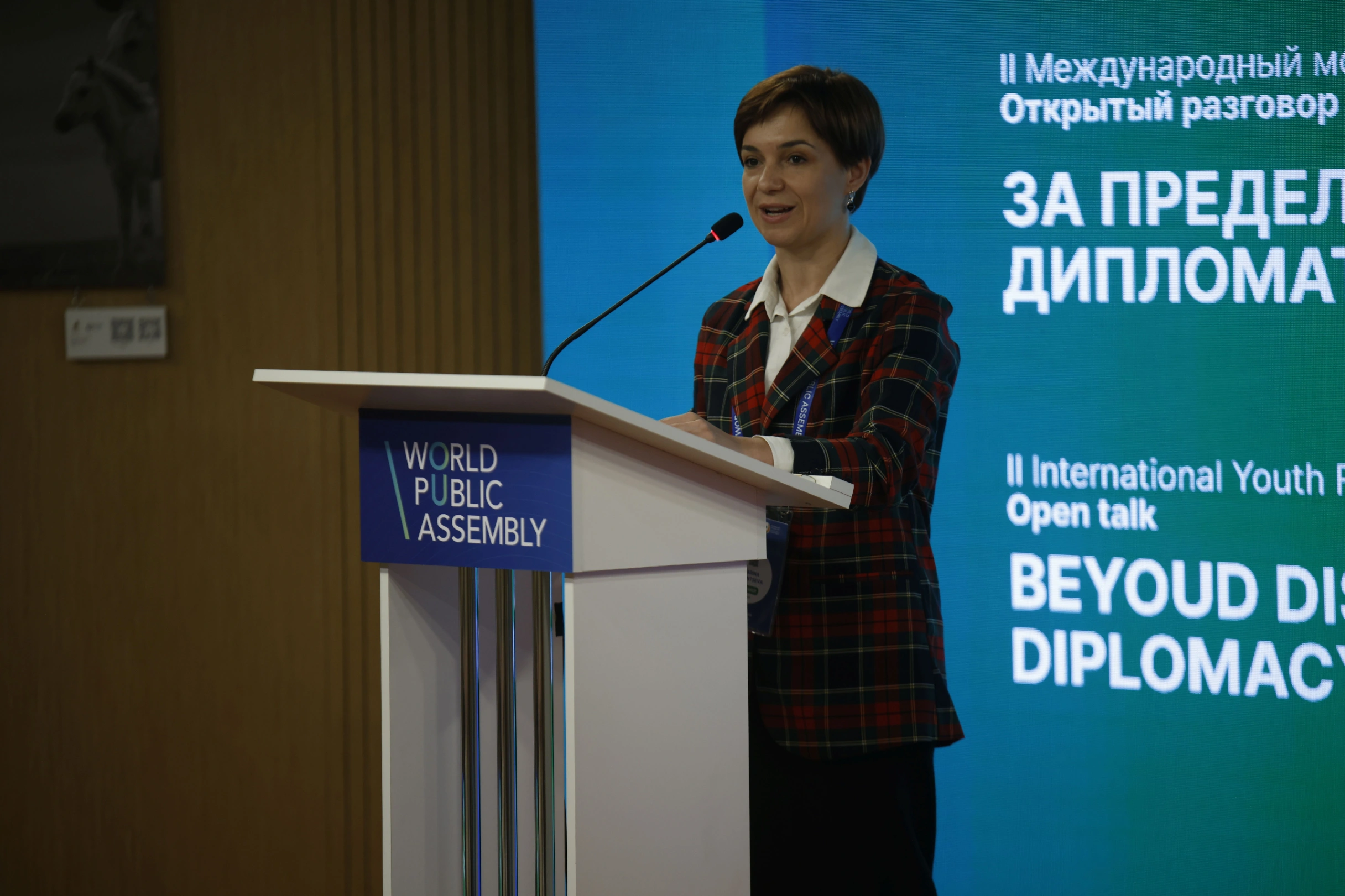
An open conversation "Beyond Differences: Diplomacy of the New Generation" was held on September 18, 2026, at the World Trade Center as part of the II International Youth Forum "Generation of Unity." The event became part of the Second World Public Assembly, taking place in Moscow from September 18 to 19.
The moderator was Marina Rybintseva, a member of the Coordination Council of the Youth World Peoples Assembly and a global ambassador of the World Youth Festival from Morocco.
Participants discussed how important it is to maintain dialogue between people and societies with different political, cultural, and value positions. Nowadays, the younger generation is actively shaping new channels of communication at a time when the digital environment creates new barriers to mutual understanding. Social networks and content distribution algorithms contribute to users becoming enclosed in information communities and to the intensification of conflicting interpretations of events. In such a situation, it is especially important not to follow biased media but to form one's own unbiased position, to strive to obtain information first-hand by expanding one's circle of contacts. In particular, this position is held by Dina Al-Bashir, a member of the Parliament of Jordan.
— Nowadays, the media are capable of completely rewriting any narrative. We, living in the Middle East, know the situation in Palestine in detail. But one only needs to cross the border into Europe to hear a completely different story: there, the media actively impose their version of events. That is why platforms such as the World Public Assembly become truly invaluable. Here it is possible to communicate personally with people from different countries, exchange opinions, and develop one's own unbiased position, the politician noted.
Christopher Helali, a journalist for DD Geopolitics and a researcher and analyst in the field of geopolitics, urged those gathered to see the whole picture and correctly assess the political and historical contexts in conflict situations:
— If we are looking for real constructive solutions and want to change the world, it is necessary to understand the root of the problem. When we deeply realize the historical context of a particular phenomenon, the question arises: how do we spread this knowledge? But what will happen if we do not have a space for dialogue? If we want to engage in diplomacy, such a space must exist. We need to unite, discuss context, and present various points of view. I strive to create exactly such platforms where bridges can be built, problems solved, and the irritation and disagreements that generate most conflicts overcome.
The speakers noted that today young leaders can create sustainable informal channels of communication between countries, forming connections that constitute an alternative to official contacts of states through diplomatic channels and government organizations. The main points of the discussion were summarized in his speech by John Aggrey, CEO of the Ghana-Russia Centre for Trade and Relations:
— There are about 1.8 billion young people aged 10 to 24 in the world. Approximately half of the world's population is under 30. This means that young people are not merely passive recipients of the fruits of international relations. Young people are full participants in this process, its interested party. And if they make up such a huge part of humanity, we cannot exclude them from key decision-making mechanisms.
The participants in the meeting also included:
Milos Tanaskovic — theologian, lawyer, founder of the Peter and Paul Foundation in Moscow;
Roman Dubinin — vice-president of the Russian-Australian Commonwealth;
Mohammad Aqil — head of Smart Mir Services, founder and chairman of the International Foundation for the Development of Education and Youth Skills.
The discussion participants agreed that civil society plays an important role in the diplomacy of the new generation. Governments and administrations may change, international priorities may shift, but relations between specific people are preserved. The enemy of diplomacy is not disagreement but the inability to interact while overcoming disagreements. Experts call for maintaining contacts at the personal level and staying together despite changes in governments.
Summarizing the discussion, the participants concluded that the exchange of experience among young leaders in public diplomacy, education, business, civic initiatives, and public communications will help determine approaches to creating sustainable spaces for open dialogue and cooperation between representatives of different countries.
Additional information is available on the official website of the World Peoples Assembly and at media@world-assembly.org.