

 Back to news
The First Youth International Forum "Unity of the Orthodox Culture of the World" took place in in Transnistria
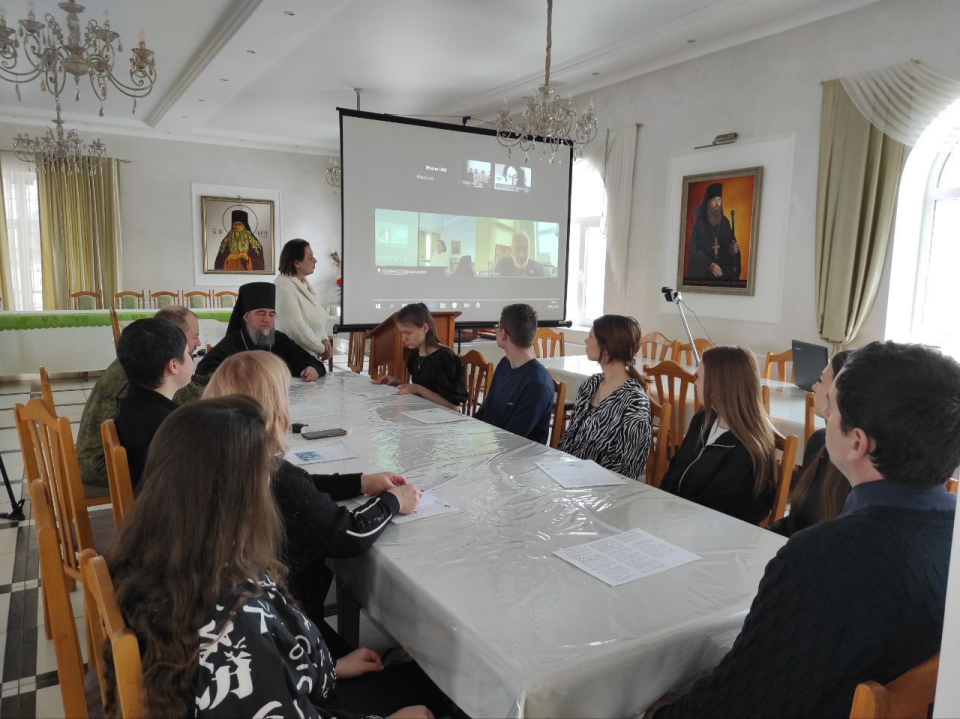
The First Youth International Forum "Unity of the Orthodox Culture of the World" was held on February 20, 2026 in the Transnistrian Kitskan Monastery. The event brought together schoolchildren, students and young researchers from Transnistria, Moldova, Bulgaria, the United Kingdom and the United States who are interested in discussing issues of preserving Orthodoxy, cultural identity and universal values in modern context.
The main subjects of discussion were:
- research on the traditions of Orthodoxy in Transnistria and Moldova;
- analysis of the role of the Orthodox community in the integration of diasporas in Bulgaria;
- the experience of preserving Orthodox identity in multicultural societies in the UK, USA and European countries.
Valery Ruzin, Deputy Secretary General of the World Peoples Assembly, spoke at the opening of the forum, emphasizing the importance of intercultural exchange for the younger generation, the potential of Orthodoxy as a factor of unity and mutual understanding between peoples, and the need to support youth initiatives in the field of studying and popularizing cultural heritage.
– Today's event proved that Orthodoxy is not only a religious tradition, but also a powerful resource for dialogue, memory preservation and building the future. The speakers emphasized the multifaceted connection of the Orthodox tradition with modern humanitarian practices such as volunteerism, culture of charity, and social solidarity. Orthodox ethics traditionally encourages service to one's neighbor as a spiritual duty. Youth volunteer initiatives in the participating countries of the Forum originate in churches and Orthodox communities. Volunteerism is perceived not as a "good deed", but as a natural expression of faith. These include assistance to those in need, care for the elderly, support for refugees, and environmental projects. The young participants showed a deep understanding of the topic and a willingness to contribute to the development of intercultural cooperation," - said Svetlana Sokolovskaya, organizer of the Forum and Head of the My Orthodox Homeland Cultural Center.
Following the results of the Forum, the following theses were formulated.
- Orthodoxy is not archaic, but a resource for the development of civil society. Its ethical standards (mercy, compassion, service) fit seamlessly into the agenda of sustainable development and human rights.
- Young people see Orthodoxy not as a barrier, but as a bridge. The Forum proved that religious tradition can be the basis for dialogue between cultures and generations.
- Volunteerism is a practical tool for the realization of faith. Volunteer projects allow young people to translate abstract ideals into concrete actions, forming a sense of social responsibility.
- Solidarity through a common mission. Joint initiatives (refugee assistance, environmental actions) unite young people, demonstrating that Orthodox values are not a path to isolation, but to openness to the world.
- The need for systematic support of volunteer projects. Their scaling requires:
- the cooperation of the Church, the state and NGOs;
- inclusion of themes of charity and solidarity in educational programs;
- popularization of successful practices through the media.
– Today, Orthodoxy is not only a liturgy and canons, but also a living practice of love for one's neighbor. Young people show that these values do not become obsolete: They take on new forms, from online volunteering to intercultural dialogues. Our Forum proved that the unity of the Orthodox culture of the world is a unity of actions, not words," - concluded Oleg Kuruch, a participant in the Forum, Deputy for spiritual and moral work of the Military Ataman of the Black Sea Cossack Army.
More information is on the official website of the World Peoples and at media@world-assembly.org.