

"Formula of National Happiness" was devised at an international roundtable in India
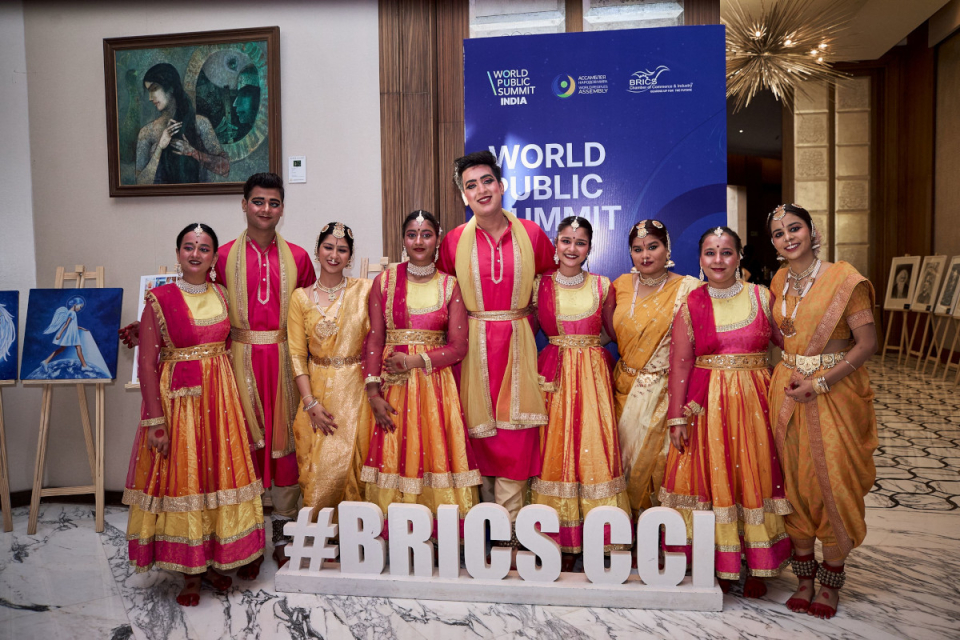
The international roundtable the "Formula of National Happiness: The Role of Traditions and Cultural Heritage in Society's Development" was held on March 26, 2026, at Vidya Bal Bhavan Senior Secondary School in Ghaziabad, as part of the World Public Summit "New World: India in the Architecture of a Shared Future." The event brought together representatives from India, Russia, Mexico, Tunisia, Malaysia, Ireland, Germany, Turkey, and Jordan to discuss the role of national traditions and cultural values in shaping a sense of happiness and well-being. The event was organized by the Department of Happiness of the World Peoples Assembly, the BRICS Chamber of Commerce and Industry, the BRICS+ Schools Association, the Representative Office of Rossotrudnichestvo in India, and the Coordination Council of Russian Compatriots Organizations in India.
The main topics of the roundtable were:
- modern practices of preserving traditions,
- the influence of culture on the development of personal qualities,
- the formation of patriotism and a positive attitude to life
- practical tools and initiatives that contribute to strengthening the spiritual foundations of nations and promoting historical heritage.
The discussion was moderated by:
- Svetlana Usenko – founder of the BRICS+ Schools Association, Honored Worker of Education of the Russian Federation (Russia);
- Kirill Chirkov – founder of the B.I.A.D. English School, member of the BRICS+ Schools Association (Russia).
The speakers included:
- Marina Volkova – Head of the Happiness Department of the World Peoples Assembly, President of the charitable foundations “Bring Good to the World” and “Bring Love to the World” (Russia);
- Datan Nair – Head of the media holding The Times Group, representative of the newspaper “Times of India” in the Russian Federation since 2000, Professor of the Department of Journalism at RUDN University, specialist in international communications (India);
- Natalia Smirnova – teacher of Russian as a foreign language, Head of educational programs in Russian as a foreign language at ALAR Training Center (Mexico);
- Olga Batakova – English teacher at the private school Charles Perrault in Tunisia, Chairman of the Coordination Council of Russian Compatriots in Tunisia (CCRT), coordinator of the Victory Volunteers in Tunisia, and national curator of the All-Russian Competition of Young Readers "Living Classics" (Tunisia).
- Alena Belozertseva – Chairman of the Russian Language Society in Malaysia, a co-founder of the Dacha Russian Language School, and a teacher of Russian as a foreign language at the University of Kuala Lumpur in the Russian-Malaysian University Program with Moscow Aviation University (Malaysia);
- Ekaterina Kudryavtseva – PhD, startup methodologist, tracker of teachers and entrepreneurs, specialist in bilingualism, profiling of people and teams, project manager, scientific head of international network laboratories “Innovative technologies in the field of multicultural education”, expert of the Federal Register of the scientific and technical sphere of the Russian Federation, expert of the Agency for Strategic Initiatives of the Russian Federation, author of methods of immersive reading, the competence field of the personality of Compass, octalysis of awareness and the pyramid of self-actualization of the personality (Germany);
- Olga Dubinova – director of the Russian school Believes (Ireland);
- Elena Steshenko – Chair of the Coordination Council of Russian Compatriots’ Organizations in Ireland, Director of the Alliance Multicultural Club, Coordinator of the Erasmus+ European Projects (Ireland);
- Sergey Chumakov – Deputy Director for Educational Work at Alma Mater School (Turkey);
- Natalia Nazarenko – Chair of the “Nadezhda” Club of Friends of Russian Culture in Amman, Organizer of Events on the Promotion of Russian Culture (Jordan);
- Alexander Usenko is the author and scientific director of the BRICS+ Schools Association, a candidate of historical sciences, associate professor at the Department of History and Cultural Studies at DSTU, head of organizational and educational work at the Institute of Creative Industries, and executive director of the autonomous non-profit organization Center for Multicultural Education and Multilingualism "World of Enlightenment" (Russia).
At the opening of the round table, Marina Volkova read a greeting from Andrey Belyaninov, Secretary General of the World Peoples Assembly:
– Let this round table and our World Public Summit become the beginning of a new stage of cooperation, mutual understanding, and friendship between the peoples of the Earth.
In his speech, Dathan Nair spoke about the importance of strengthening the spiritual foundations of the nation and preserving its historical heritage:
– In the current political climate, it is essential to talk about cultural basis and historical heritage.
Natalia Smirnova provided a detailed account of her work with foreign students:
– By teaching them Russian, we bring up friends and partners of Russia.
Olga Batakova added:
– In the modern world, we face an important task: to preserve our identity and our connection to our historical homeland. This is facilitated by the organizations of compatriots who live outside the Russian Federation. Our main goal (as compatriots) is to consolidate.
Alena Belozertseva explained how culture supports those who live abroad.
– Happiness is often associated with simple things, such as a sense of security and belonging. Culture provides these feelings.
Elena Steshenko used the example of Ireland to talk about the importance of cultural dialogue as a key to successful integration for teenagers from migrant families, and Olga Dubinova shared information about how historical memory is preserved in Ireland, including the "Bouquet of Victory" flash mob.
Ekaterina Kudryavtseva noted:
– We are moving away from globalization towards cultural multi-layeredness and deglobalization. This leads to instability and a very large cultural multi-layeredness. In such conditions, bilingualism becomes the norm for survival.
In his speech, Sergey Chumakov spoke about the importance of preserving and transmitting cultural values:
– The volunteer movement plays a crucial role in this process, as it involves people in the preservation and transmission of cultural values through action. Historical reenactments can also be very effective in this regard.
Alexander Usenko concluded the roundtable by saying:
– We are always searching for a formula for happiness, but it is important to understand that not all traditions lead to happiness. Let us not preserve cultural ashes, but rather preserve the fire!
He added that countries that attract women to municipal and government positions develop faster and have higher levels of happiness.
The roundtable discussion can be viewed on YouTube and RuTube.
The World Peoples Assembly is an international union of non-governmental organizations that forms a humanitarian platform for cooperation between the peoples of the world based on trust, mutual respect and common values.
Media accreditation for the Summit, cooperation issues: media@world-assembly.org, +7 (985) 768-2053 (Oksana Leontieva).
More information is on the official website of the World Public Summit.
Video — follow the link .
Photo — follow the link .