

The New Delhi Summit discussed Cinema as a Tool of Public Diplomacy and Launched New International Projects
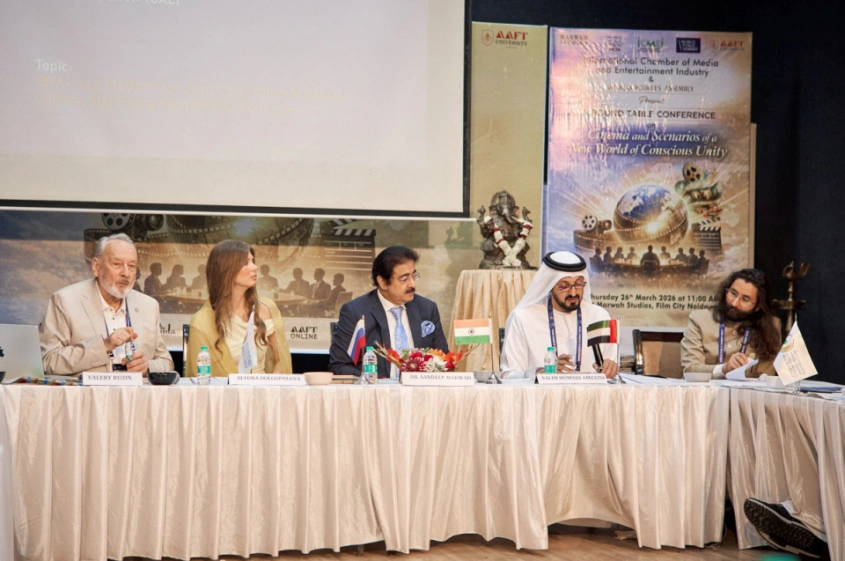
On March 26, 2026, the Marwah Studios in New Delhi hosted the International Public Forum "Cinema and Scripts of a New World of Conscious Unity". Organized by the World Peoples Assembly and Marwah Studios, the event was held as part of the World Public Summit: India "A New World: India in the Architecture of a Shared Future". It brought together experts, representatives of the film industry, media, education, and public diplomacy from 8 countries: India, Russia, the UAE, the USA, Canada, Hungary, France, Serbia, and Israel. The Forum became one of the key humanitarian platforms of the Summit. It discussed the issues of international cooperation through the lens of screen culture, creative industries, and cultural diplomacy. The program of the Forum opened in an atmosphere of respect for the cultural traditions of India: the event began with a ceremony of lighting lamps and performing “Ganesha Vandana". This symbolic gesture set the tone for the entire subsequent discussion. The culture was presented as an independent force capable of building trust, uniting societies and launching long-term humanitarian processes.
The Forum's key partner from India, the Asian Academy of Film and Television (AAFT) is one of the leading international educational platforms in the field of cinema and media. On the Indian side, the Forum was moderated by its founder and president, the creator of Marwah Studios, the president of the World Peace Development & Research Foundation, and a well-known public figure, Sandeep Marwah. On the Russian side, the meeting was moderated by Valery Ruzin, Deputy Secretary General of the World Peoples Assembly, President of the Vladimir Menshov International Film Festival "Won Together," and President of the Eurasian Academy of Television and Radio.
In his speech, Sandeep Marwah emphasized that, today, cinema is a universal language of international communication and has the power to bring people together, creating a space of mutual understanding between different cultures and societies.
– Cinema is not just a means of entertainment, but a powerful language that unites the world, - he said.
Sandeep Marwah also highlighted the practical significance of educational and cultural exchange. He announced his readiness to expand scholarship and short-term programs for students from different countries, so that young people can get to know India better through education, media practices, and radio and television platforms.
– The most important task of the Summit is to spread peace through art and culture, – he emphasized, directly linking the prospects of international cooperation with youth policy, creative education, and joint cultural initiatives.
The Forum culminated in the presentation of the "Leader of Public Diplomacy" award to Sandeep Marwah, in recognition of his many years of work in promoting international cultural cooperation, advancing humanitarian initiatives, and strengthening ties between nations through the arts, education, cinema, and public diplomacy.
Official Secretary Alyona Dolgopolova delivered a welcoming speech on behalf of the World Peoples Assembly. She presented the Assembly's activities as an international platform for public diplomacy and recalled the First World Public Assembly held in Moscow in 2025, describing it as an important milestone in the development of a new format for multilateral public dialogue. Alena Dolgopolova emphasized that the current Forum in India is a continuation of the ongoing work to establish sustainable humanitarian ties between countries.
– It was a very fruitful discussion. We covered topics such as new media, documentary films, film production, and especially cooperation between Russia and India. With the help of cinema and the media, we can shape a positive agenda right now, - she added.
Valery Ruzin drew the participants' attention to the fact that modern cinema and visual culture are becoming the language of the future, which is already being spoken by the new generation. He emphasized that this is not just about cinema as an art form, but also about a holistic humanitarian environment where new meanings, values, and models of international cooperation are being formed.
– A philosophical approach allows us to see behind the story of the Epstein Archipelago the deepest shifts in the very paradigms of thinking of the modern world, which is moving towards its dehumanization, towards a catastrophic fall – from God to the devil, from the Spirit to the blind and shameless flesh, from beauty to aggressive ugliness, from virtue to offensive vice. We are coming together to resist vice,” - said Valery Ruzin. – In youth trends, there are flows of time, processes, and cascades of meanings. This is the element of life in its fullness. Here, meaning blocks are born, predetermining the content of everything that our minds deal with.
Grigory Pelman, President of the NGO One Future (Israel–Russia), participating online, spoke on the topic “Cinema as a Mirror of a United Humanity: Shared Values in a Multipolar World.” He used examples to demonstrate how art and visual imagery can bring a humanitarian dimension back to international dialogue and inspire a sense of shared future among the younger generation.
Rohini Khak, Founder of the NGO HopeBlit (India–USA), presented a speech “Micro-Documentaries about Children’s Lives in India: A Tool for International Solidarity and Social Support.” Her presentation set a strong humanitarian emphasis on the entire discussion, showing that cinema can not only tell stories, but also amplify the voices of those who are usually left on the periphery of public attention, becoming a tool for real social change and international support.
The Director of the Center for Creative Industries at SPbGUPTD, Professor, Doctor of Economics, Alexander Evmenov, presented the report “The Experience of the Olympic Channel Association International Program Aimed at Combining Broadcasting and Education”. He spoke about successful international practices of combining educational tasks and media production, as well as the possibilities of scaling such models for youth programs and international creative projects.
Salim Humaid Saif Humaid Amzaini (UAE), Founder and President of the BRICS+ Cultural and Sports Forum (BIFA+), spoke on the topic of "Sports Diplomacy" and presented the concept of sports, culture, and cinema as a unified platform for cultural diplomacy. In his speech, he highlighted sports as a universal language of participation, respect, and human connection, complementing cultural and media formats for international cooperation.
Sergey Khalkov, CEO of Silk Road Media (Russia), in his report "Microdramas as a new language of Global BRICS+ Dialogue", identified short screen formats as one of the most promising areas of international cooperation, especially in the Russia-India and broader (BRICS+) context. He stressed that micro-dramas and short digital formats make it possible to work quickly and organically with a youth audience, while maintaining a meaningful and valuable depth.
Anil Polala, CEO of Silly Monks Entertainment LTD (India), presented an applied perspective on the specifics of the Indian film market, focusing on industrial mechanisms, distribution, digital audiences, and opportunities for international cooperation, considering the specific features of the Indian market.
Director, screenwriter, and producer Galina Yevtushenko (Russia) spoke online on the topic "At the Crossroads of Cultures: India in the Films of Galina Yevtushenko." Her participation was an important contribution to the development of the topic of cultural relations between Russia and India in documentary film, as well as a confirmation that the long-standing humanitarian interest in Indian themes already has its own screen history and a serious authorial tradition.
Professor Konstantin Glasman of LETI gave an online presentation "One Future International Hackathon: 24-Hour Cinema as People's Diplomacy." He presented the format of rapid collective filmmaking as a modern practical tool for youth collaboration that combines creativity, teamwork, and intercultural communication.
Alexey Demidov, Rector of the St. Petersburg State University of Industrial Technologies and Design, Vice-President of the Russian Union of Rectors, delivered an online presentation "Social Fashion as a Visual Code for a Multipolar Future." His presentation expanded the scope of the Forum, demonstrating that the visual language of the future is being shaped not only in cinema, but also in design, fashion, and other forms of creative expression that directly engage with young audiences.
In his online presentation "The Path of People's Diplomacy as a Life: The Example of Giuseppe Castiglione," journalist and filmmaker Matthew Erett (Canada) drew on the historical example of cultural mediation and intercivilizational dialogue, demonstrating that cultural diplomacy has deep historical roots and remains relevant in the 21st century.
Among the international participants of the Forum were political scientist, historian, and public figure Hélène Perroux (France) and Zoran Mrdjenović, Chairman of the Board of Directors of the Royal Order of Serbian Knights and Director of the International Festival of Culture and Art "Vityaz Fest - Spirit of the Slavs" (Serbia).
The main issue of discussion was the question: what language can unite the younger generation on a global scale today? The participants concluded that modern cinema and digital video are becoming one of the key languages of international communication. Short formats, micro-dramas and music videos shape a new global consciousness, and screen culture increasingly becomes a tool of public diplomacy.
An important part of the program was the film screenings for students, which took place at the Marwah Studios on March 24 to 27, 2026. For the youth audience, screenings of films – winners of the Vladimir Menshov International Film Festival “Won Together” were organized. They allowed to supplement the expert discussion with real artistic experience and to include students in a direct conversation about the content of modern documentary and feature films.
A special place in the cultural program was taken by the screening of Galina Yevtushenko's film "Leo Tolstoy and Mahatma Gandhi" on March 26. After the screening, there was a discussion with the students; the film director herself took part in it an online format. This format of a live conversation after the screening was a clear example of how cinema can work not only as an artistic statement, but also as a space for dialogue, reflection on history, values, and cultural connections between countries.
As a result of the work, six protocols were signed, which take the discussion from the realm of ideas to the realm of concrete actions. Among the key decisions:
the creation of an international working group for the implementation of the project “Social Fashion as a Visual Code of a Multipolar Future”;
the formation of an international joint working group for the creation and development of the permanent summer and winter microdrama film school “Unity” as an educational and creative platform for young people;
the development of the international coproduction system “India – Russia – BRICS+ countries” in cinema and creative industries;
the launch of joint initiatives in sports, culture and media within the BIFA+;
strengthening the role of youth in public diplomacy on the platforms of the World Peoples Assembly and the BRICS+ Culture Media Forum.
The signed documents are not only symbolic, but also have an organizational significance. They provide for the establishment of working groups, the preparation of roadmaps, the appointment of responsible representatives, the submission of project proposals and the launch of pilot initiatives as early as in 2026. At the center of these agreements are young people as the main participants in future international humanitarian processes, as well as cinema, media, culture, education, and interpersonal interaction as the common infrastructure of new cooperation.
The Forum confirmed that international humanitarian cooperation is now being built not only through official channels, but also through shared creative experiences, educational initiatives, screen culture, and creative industries. The International Public Forum "Cinema and Scripts for a New World of Conscious Unity" has become a launch point for a new practical agenda, where cinema acts as a language of trust, young people become active creators of international projects, and signed international protocols lay the foundation for long-term cooperation between BRICS+ countries.
The World Peoples Assembly is an international union of non-governmental organizations that forms a humanitarian platform for cooperation between the peoples of the world based on trust, mutual respect and common values.
Media accreditation for the Summit, cooperation issues: media@world-assembly.org, +7 (985) 768-2053 (Oksana Leontieva).
More information is on the official website of the World Public Summit.