

 Back to news
“Aggregator of Happiness” Speaks the Language of the World: The World Peoples Assembly Presented the First English-Language Issue of the Magazine
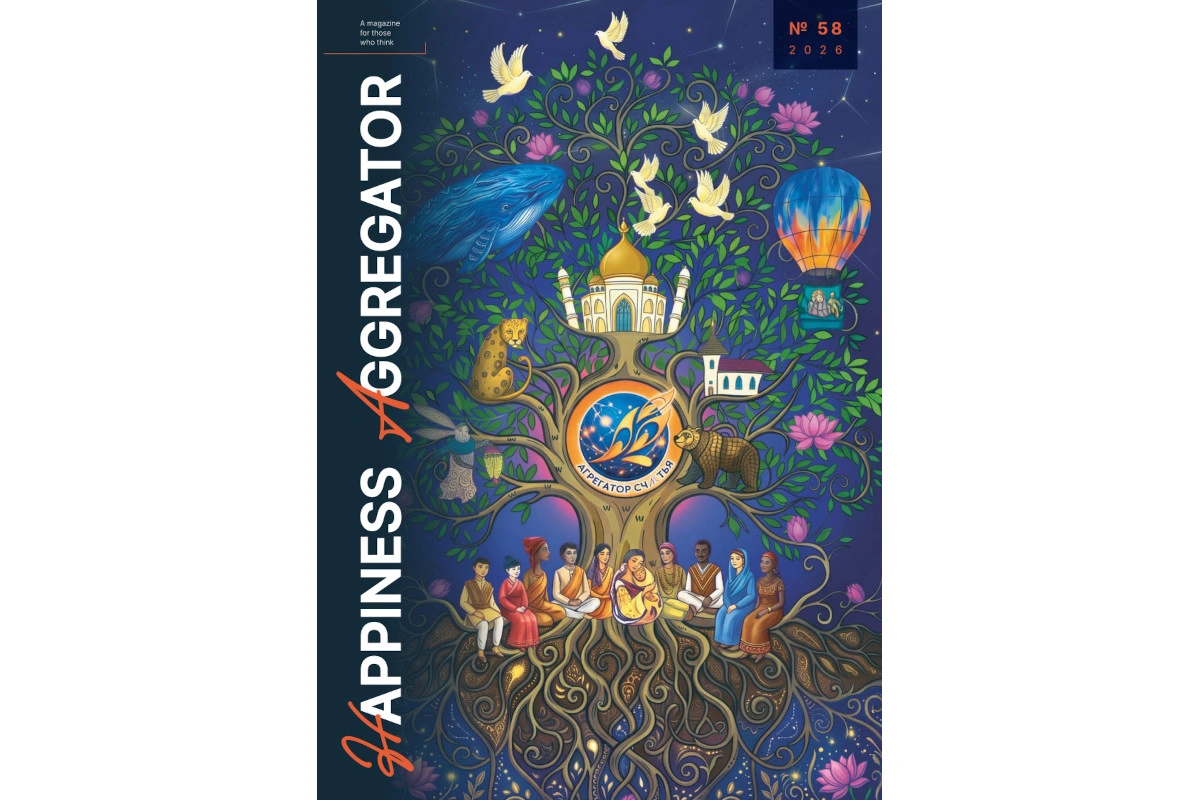
The World Peoples Assembly presented the first English-language issue of the “Aggregator of Happiness” magazine. For six years, the publication was released in Russian and built a wide readership in the CIS countries and beyond. In response to readers’ requests to expand the magazine’s geography, a full-fledged English-language version was prepared, designed to ensure international dialogue and present the magazine’s concept to a global audience.
A global view of the nature of happiness
In the English-language issue, the editorial team presented the results of many years of research devoted to how the phenomenon of happiness is interpreted in various cultural contexts – in the Arab world, the USA and China. The differences in understanding this concept are significant: for some, happiness manifests itself in silence and contemplation, for others – in a noisy family feast, for others – in service and creation. However, despite all the distinctive specifics, the foundation remains common: the need for belonging, inner support and meaningfulness of existence. This universal base, uniting billions of people, is what the new issue of the magazine proposes to explore.
The symbol on the cover – a manifesto of unity
The cover of the magazine features the “Shawl of Happiness” – an amazing art object created based on the works of participants of the international festival “The World Draws Happiness.” The silk souvenir has become a symbol of unity, a visible sign of belonging to a community that believes in the power of goodness and mutual understanding.
The pattern of the shawl merges fragments of drawings by people from all continents. The center of the composition is occupied by the majestic Tree of Life: its roots go into traditions, the trunk symbolizes our common Earth, and the branches reaching toward the light personify hope. The heart of the shawl is the feather of the firebird, a sign of the creative energy that every person carries within. Along the edges of the item, the phrase “The World Draws Happiness” is written in calligraphy in Russian, English, Chinese and Arabic. This “linguistic ring of the world” sounds like a call: our world is what we create with our own hands, thoughts and creativity.
The concept of the future through the “happiness filter”
The main conceptual highlight of the English-language issue was the presentation of the editorial team’s new idea – the “rating of future norms.” The magazine proposes to evaluate new social and technological standards not by parameters of profit and economic efficiency, but by the level of happiness they bring to people. Any new standard is now proposed to be passed through a “happiness filter”: how will it change people’s lives, will the world become more humane. In this way, the magazine continues its main mission – to show that happiness is not an accident, but a conscious path that we walk day by day – together with others.
Happiness as a common cause: voices of those who create the magazine
Representatives of the publication and the World Peoples Assembly speak about the meaning of happiness and the role of the English-language issue of the “Happiness Aggregator” magazine. Despite differences in approaches, all participants agree on the key conclusion: well-being is formed through interaction between people and the willingness to give knowledge, experience and attention to those who need support.
Marina Volkova: “Happiness is a bridge between hearts”
For the founder of the magazine and head of the Department of Happiness of the World Peoples Assembly, Marina Volkova, the English-language issue is a true bridge: between cultures, between different ideas about happiness and, most importantly, between the hearts of people who want to live consciously and make the world brighter:
– For six years now, “Aggregator of Happiness” has been published in Russian, and during this time we have become convinced of how universal the very striving for happiness is. Today the magazine is known in various regions of Russia, it has found a lively response among readers from Vladivostok to Bishkek, from Minsk to Yerevan. And more and more often the same request was heard: to make the publication accessible to those who do not read Russian. Thus, a personal request became a common task – to give the text the opportunity to cross a language border without losing its meaning.
Andrey Belyaninov: “Happiness is when you are understood”
Secretary General of the World Peoples Assembly Andrey Belyaninov views happiness through the prism of mutual understanding and readiness to share positive experience:
– For millennia, humanity has been accumulating this happiness within itself – what is called cultural and spiritual heritage. And one must not just think a lot about this, but think, speak and create, so that the happiness residing within every person can be given to others.
The Secretary General of the World Peoples Assembly recalled the catchphrase from the film “We’ll Live till Monday”: “Happiness is when you are understood.” According to Andrey Belyaninov, it contains the essence of everything the magazine talks about. And the public figure sees the meaning of public diplomacy in people’s ability to hear each other, even when languages, traditions and habits differ radically.
Oksana Margiani: “Happiness as inner support”
Editor-in-chief of “Happiness Aggregator,” psychologist, Honored Worker of Culture of the Russian Federation Oksana Margiani, in the magazine’s author column, examines the popular misconception that happiness is a life without problems. However, in the world there are many people living in difficult conditions, facing deprivation, poverty and illness, yet feeling happy:
– The feeling of happiness is born inside – where a quiet state of depth, calm and understanding that everything is going as it should live. This quiet inner happiness guides a person through the steepest trials, serves as their inner core.
The key to such support, according to Oksana Margiani, lies in the practice of self-knowledge: one must engage in self-analysis, pose critical questions to oneself and find answers to them, clearly define one’s own values and meanings, and also objectively assess one’s own weaknesses. Only in this case can external circumstances and influences fail to affect a person’s inner state of well-being. Equally important is a careful attitude toward one’s own energy:
– Any action requires energy, and it can be taken from those who themselves give it. When we react to events without thinking, we give away a colossal amount of our energy, but when we observe and consciously choose a reaction, we preserve it and nourish our inner state of happiness regardless of circumstances. All this can be learned on the pages of the magazine. The editorial team tells how to do it.
Oksana Margiani’s slogan, which has become a guide for the publication, sounds like an invitation to reflection and action: “‘Aggregator of Happiness’ is a magazine for those who think. Let’s think together and multiply happiness in the world!”
Svetlana Smirnova: “Happiness is in trust and dialogue”
For the Chairperson of the General Council of the World Peoples Assembly, Doctor of Political Sciences Svetlana Smirnova, public happiness begins where people feel heard, where rules are clear and fair, where culture and education help a person reveal their potential and direct it for the benefit of society. Svetlana Smirnova’s work in the World Peoples Assembly is the practice of such an agenda:
– Supporting public diplomacy projects, developing horizontal ties between communities, creating conditions where local initiatives can influence large processes – all these are ways to turn “happiness as a common cause” into working mechanisms. In other words, trust between people and nations does not arise on its own; places and occasions must be created for it.
Platon Mersiyanov: “Happiness is action”
“Ambassador of Happiness” Platon Mersiyanov shared his observations made during the World Public Summit in Ethiopia:
– During my speech, there was complete silence in the hall. I was talking about opportunities for young people to participate in international social projects and thereby raise the level of happiness of people around them. Until the very end of my speech, I could not understand the reaction of the audience, whether the topic was close to them, why they were sitting so motionless. But as soon as I finished, I was simply bombarded with questions. Many shared their formula of happiness, writing it right on the stand. And then I realized that we were talking about the same thing: regardless of nationality, everyone strives to surround themselves with people whom one can help and who will help you, in order to fill life with meaning.
Platon Mersiyanov emphasized that for young people, happiness is not a passive state but an action: to notice the good, support another, create something useful and launch a chain reaction of goodness. It is young people today who are becoming the most active conduits of this idea: they do not wait for the world to become kinder, but make it so here and now.
Irina Markova-Shagal: “Happiness is in creativity”
For the grandniece of the famous painter Marc Chagall, artist, poet and public figure Irina Markova-Shagal, happiness is inseparable from creativity and responsibility for the world around:
– It is not only an inner state, but also a daily choice of creation, care and respect for one’s native land and for the entire planet.
It is from these positions that Irina Markova-Shagal will lead the International Festival “The World Draws Happiness,” whose chairmanship she will assume in 2027. Over four years, the festival has united participants from 58 countries, and their creativity has become a message of humanity, in which the voices of different cultures are heard but one common note sounds – the desire to see the world kind, just and beautiful. The festival will be held under slogans that set a whole philosophy of action:
“Happiness is where it is cherished: for oneself, for the Motherland, for the Earth”;
“We draw a world in which we want to live. We travel, leaving only a trace of happiness”;
“The house of happiness is our Earth. Favorite places are in the heart. Responsibility is in every step.”
World Peoples Assembly: a space where mutual understanding is born
Happiness develops in dialogue – it needs meetings and people ready to create it. The World Peoples Assembly serves as exactly such a platform, where public diplomacy finds practical embodiment in specific projects.
The “Ambassadors of Happiness” movement has received support from the Presidential Grants Fund, the festival “The World Draws Happiness” unites tens of thousands of participants from different continents, and youth diplomacy projects are becoming schools of trust where young people learn to hear each other despite linguistic and cultural differences. All this is the living practice of the philosophy that the pages of “Aggregator of Happiness” speak about: well-being is not an individual category but a common result.
– There is a “theory of two percent”: when only 2% of people in the world begin to think and speak about something, this idea very soon becomes a new paradigm for the whole society. The English-language issue is our step toward making such people more numerous, so that the conversation about happiness sounds in new languages and reaches new hearts, – the magazine’s editorial team notes.
The first English-language issue of the “Aggregator of Happiness” magazine is already available, and its authors hope that this issue will become an occasion for new conversations, meetings and deeds that make the world kinder.
– Let happiness become a common language that everyone understands, – the editorial team urges.
Additional information is available on the official website of the World Peoples Assembly, on its VKontakte and Telegram accounts, and at media@world-assembly.org.