

 Back to news
“An Ode to Eastern Hospitality”: The World Peoples Assembly Releases a New “Scarf of Happiness”
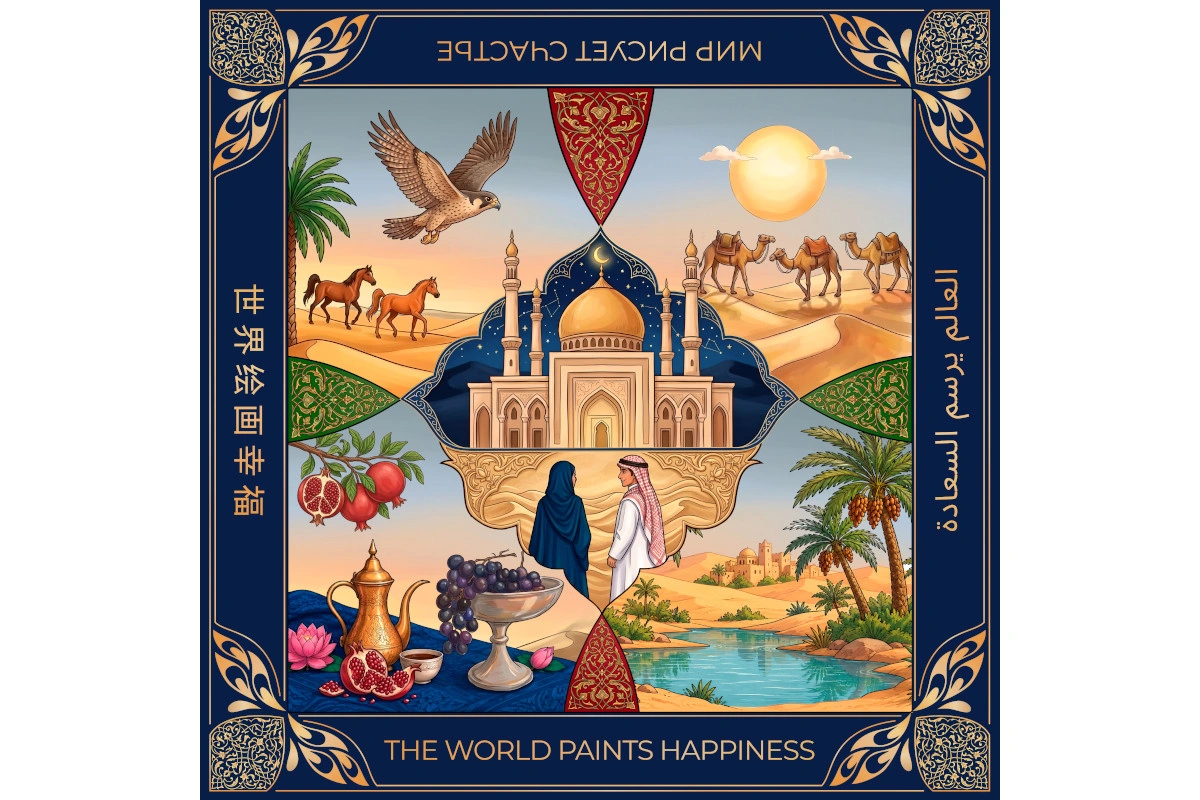
In autumn 2026, the World Peoples Assembly and the Center for Social and Cultural Rehabilitation and Development “Happiness Aggregator” released a new “Scarf of Happiness” - an eastern one this time. Creating such silk accessories based on the works of participants in the International Festival “The World Paints Happiness” has already become a good tradition. Each scarf is an artistic manifesto: the voices of thousands of people, children’s sketches and adults’ painted images, profound symbols and meanings are interwoven within them. Thus, the idea of happiness becomes visible, tangible and close to everyone.
The new scarf is an ode to the East: its rhythm, colours and philosophy of hospitality. It seems to invite us on a journey through time and space to hear how happiness sounds in different languages and cultures. Along the edges of the item, the phrase “The World Paints Happiness” is written in calligraphy in Russian, English, Chinese and Arabic. This “linguistic ring of the world” sounds like a call: our world is what we create with our own hands, thoughts and creativity.
The Heart of the Composition - an Arab Temple is at
At the centre of the scarf there is a majestic mosque, or masjid, which in Arabic means “a place of worship.” Through its open doors walk a man and a woman in traditional attire: he wears a long kandura, while she wears an abaya and an elegant hijab. Their figures are not static: in their very movement one can sense a step towards each other and towards the world - a readiness for dialogue, respect for tradition and openness to the future. It is an image of family, union and mutual trust - the very foundations on which human happiness rests.
The Symbolism of Details: A Language Understood Without Words
Every detail of the scarf is a separate line in this visual poem:
Horses are symbols of nobility, strength of spirit and faithfulness to one’s path. In Eastern culture a horse is not merely a vehicle but a companion embodying honour and dignity.
A soaring eagle is a sign of lofty aspirations and freedom from prejudice. It sees everything at once: the sands, the oases and the roads that connect people.
Camels are “ships of the desert,” symbols of endurance and patience. For centuries they have connected caravan routes, carrying not only goods but also knowledge, culture and good news.
A large yellow sun is the source of life and light. It unites all the elements of the composition, reminding us that happiness is the energy we give to one another.
Palm trees and a lake are an oasis as a metaphor for hope. The palm tree symbolizes resilience and fertility, while the lake is a mirror of inner tranquility and purity of thought.
A jug represents readiness to share water and attention: to offer a traveler water is to open one’s heart to them.
A pomegranate stands for fertility and abundance: its seeds are scattered across the pattern like a promise of new opportunities.
Grapes in a vase signify the joy of communication and the sweetness of good deeds: happiness is born in shared moments.
A full cup represents abundance that begins with generosity of heart: true wealth lies not in accumulation but in the ability to give.
A special artistic accent is the lotus beside these objects. Surrounded by earthly gifts, it seems especially expressive: a symbol of purity and inner blossoming, reminding us that even amid abundance it is important to preserve a bright essence and strive for harmony.
Together these images form a coherent philosophy: happiness lies in the balance between the material and the spiritual, in the ability to value simple things and to share beauty with the world. The Eastern ornament is a delicate weave of patterns with no beginning or end - an image of the eternal movement of life and the interconnectedness of all people and cultures.
A Tradition That Unites
The release of “Scarves of Happiness” is not a one-off project but a living tradition that gains new colours each year. It was born from the International Festival “The World Paints Happiness,” where children and adults from 58 countries learn to speak a single language of creation. Over the years of the festival’s existence, more than 47,000 people have taken part in it, and every drawing is a small message of humanity.
The World Peoples Assembly and the Center for Social and Cultural Rehabilitation and Development “Happiness Aggregator” carefully gather these messages and transform them into symbols that can be carried with. The scarf becomes a visible sign of belonging to a community that believes in the power of kindness and mutual understanding. By wearing it, a person declares without words: “We are different, but we choose happiness.”
Today, the Eastern-style “Scarf of Happiness” is an official attribute of “Ambassadors of Happiness” and participants in the festival programs. It accompanies delegations at international meetings, adorns exhibitions and displays, and serves as a memorable gift carrying not only artistic but also profound meaningful value.
An Invitation to Participate
The tradition of the “Scarves of Happiness” continues. Your drawing or your child’s drawing may appear in the next edition. The festival “The World Paints Happiness” is open to everyone who wishes to share their vision of kindness, beauty and harmony.
“May this scarf become for you not just an accessory, but a small talisman - a reminder that happiness is born where hearts meet, where traditions are respected and where people look boldly to the future. May it become a reason for conversation, a smile for a stranger, a gesture of support and a symbol of the fact that the world can truly be drawn - with a line, color and a good deed,” - the project’s creators call upon people.
Additional information is available on the official website of the World Peoples Assembly, on its VKontakte and Telegram accounts, and at media@world-assembly.org.