

 Back to news
Laureate of the First World Public Recognition Award "For Service to Humanity" Sabena Yohannes Delivers a Call to Humanity
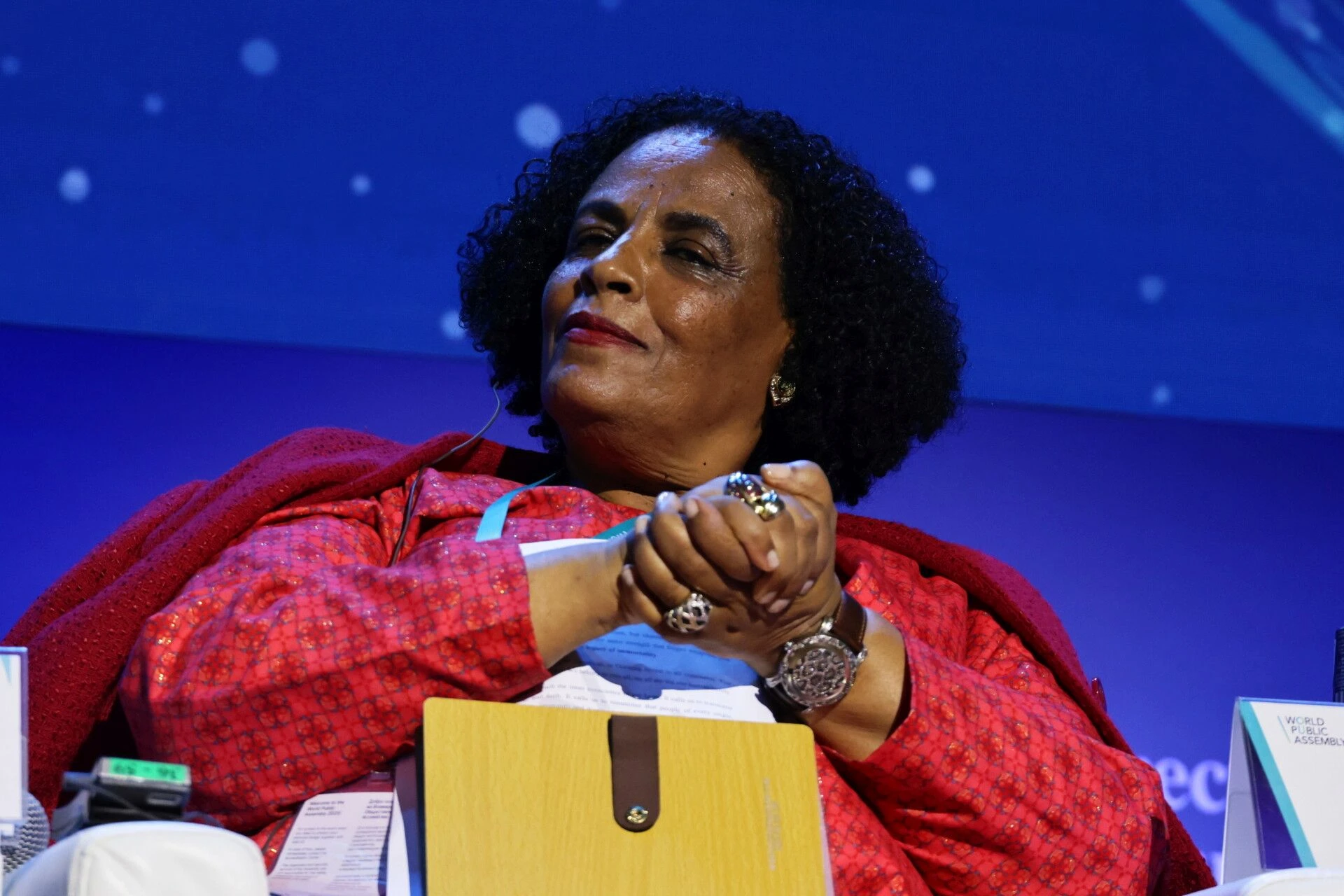
Sabena Yohannes, Founder and CEO of Afritrack Angola, Laureate of the First World Public Recognition Award "For Service to Humanity," delivered a call to humanity ahead of the Second World Public Assembly "New World: Values That Unite," which will be held in Moscow on September 18–19.
THE VOICE OF MOTHERS
Today, as the world goes through a difficult time, it is especially important for us to remember a simple truth: above all, we are human beings.
Before nationality, religion, social status, political views, and any other differences, there is a human being. We feel pain the same way. We love our children. We fear losing our loved ones. We hope for the future.
That is why I address myself first and foremost to the mothers and women of the world.
Raise your voice. Speak of compassion. Speak of human dignity. Do not remain indifferent to the pain of others.
I am not calling for anyone to take a political side. I am calling for us to take the side of humanity.
The Voice of Women
I do not have the power to stop conflicts or change the decisions of states. But I have a voice.
And I believe that the voice of a woman, the voice of a mother, is capable of reminding a person that no power, no convictions, and no circumstances can negate our belonging to one human family.
Every leader was once a child. Everyone has a family, loved ones, people they love.
A woman can address not only a position or a status — she is capable of addressing the human heart.
Therefore, the voice of mothers can become a moral voice that does not accuse, but reminds us of the value of human life.
Dignity Requires Opportunity
Once I saw a pregnant woman who, together with her small child, was collecting plastic waste. She told me she had been left without support and had not eaten anything for two days.
We helped her with the bare necessities. But I thought: giving a person help today is not enough. What will happen tomorrow?
I asked her what she could do. She replied that she could bake small pies and sweets and sell them if she had start-up capital.
I gave her the necessary funds. Three weeks later, she told me she had managed to triple the initial amount.
This case reminded me once again: assistance should not only support a person, but also give them the opportunity to stand on their own two feet.
Dignity requires not only support. It requires opportunity.
Knowledge Needs Humanity
Knowledge is one of the greatest powers a human being possesses. But knowledge alone is not enough.
One can be perfectly educated and yet not feel another's pain. One can create the most advanced technologies and forget for whom they are being created.
Therefore, knowledge needs humanity.
We must learn throughout our lives. A true student is not one who has received a diploma and decided that education is finished. A person remains a student as long as they retain curiosity, the ability to ask questions, and the desire to understand the world.
Our children must study not only technology. They need history, culture, art, literature, philosophy — all that helps a person understand another person.
Culture Reminds Us Who We Are
The love of art is, in a certain sense, the love of humanity.
Music can speak without translation. Poetry and literature allow us to feel the life of another person. Culture connects generations and peoples.
We can admire Beethoven and Shakespeare while at the same time discovering the great heritage of Africa, Asia, the Middle East, Europe, the Americas, and other regions of the world.
Every culture adds its own voice to the shared human symphony.
Words, too, possess enormous power. They can divide, but they can also reconcile. Therefore, it is our responsibility to use the word not to multiply enmity, but to awaken conscience.
Technology and Human Responsibility
We live in the 21st century. Humanity possesses artificial intelligence, advanced technologies, and a vast amount of knowledge.
But technological progress alone does not make society more humane.
Technology without moral responsibility can increase not only the possibilities of creation, but also the scale of destruction.
That is why what we pass on to the next generation is especially important.
Education, cinema, literature, the media, and the digital environment must tell not only of confrontation and destruction. They must show creation, discoveries, culture, history, human solidarity, and the ability of people to cooperate.
Remembering History Without Inheriting Hatred
History cannot be changed.
Destroyed monuments, temples, museums, and cities cannot simply be restored to their original human and cultural significance. The loss of human life is all the more irreplaceable.
We must remember the tragic pages of history. But we should remember them not in order to pass hatred on to the next generations.
We must remember history so as not to allow tragedies to repeat themselves.
Historical memory should help us become wiser and more responsible.
Africa Needs Partnership, Not Patronage
Africa is a young continent with enormous human and natural resources and an increasingly significant role in the future of the world.
It needs not patronage, but equal partnership.
Universities are needed. Technologies. Scientific research. Centers of excellence. Exchange of knowledge. Opportunities for young people to create something new.
We need not only to help a person — we need to create conditions in which they can reveal their own abilities.
I have tried to follow this principle in my work in the field of education and development.
Because our true legacy is not only what we owned.
Our true legacy is what we created and what we helped others to create.
The Voice of Civil Society
The world cannot be changed by the efforts of politicians alone.
A humane civil society is needed — a society that possesses a conscience and is capable of peacefully, consistently, and responsibly upholding the value of human life.
Public leaders, scientists, entrepreneurs, cultural figures, religious leaders, journalists — each bears their own measure of responsibility.
And women, too, possess enormous power.
Not the power of pressure, but the power of compassion, moral courage, and the ability to address the human heart.
What Makes Us Human?
The modern world too often makes us evaluate the external: clothing, status, material means, position in society.
But perhaps we should more often ask a different question: not what makes us more significant in the eyes of others, but what makes us more human?
What does wealth mean if nothing remains after us that helped others?
What does knowledge mean without conscience?
What does development mean without compassion?
Therefore, I appeal to entrepreneurs, scientists, public leaders, creative people, and all who have the ability to influence the future: invest in humanity.
Help overcome hunger. Support education. Develop science. Seek new ways to treat diseases. Create opportunities for others. Build Peace.
From Darkness to Light
Perhaps we are unable to change the whole world instantly. But that does not mean we can do nothing.
Even a small light can show the way in the darkness.
A great journey begins with the first step. One voice may seem too quiet. But many voices can create a symphony of peace.
Sometimes we need to stop looking only outward and look within ourselves.
To ask: "What would I feel if this was my child? My mother? My family? What would I feel if someone else's tragedy entered my own home?"
Each of us has the capacity for compassion. And before all differences, we are human beings.
Raise your voice. Speak from the heart and conscience. Do not turn away from another person's pain.
Let the voice of mothers become the voice of humanity.
The discussion of humanity and eternal values will continue at the Second World Public Assembly "New World: Values That Unite." The program of the event can be found at the link.
Additional information — on the official website of the World Peoples Assembly and at media@world-assembly.org.