

 Back to news
The II International Youth Forum “Generation of Unity” held within the Second World Public Assembly Discussed What the World of the Future Will Be Like
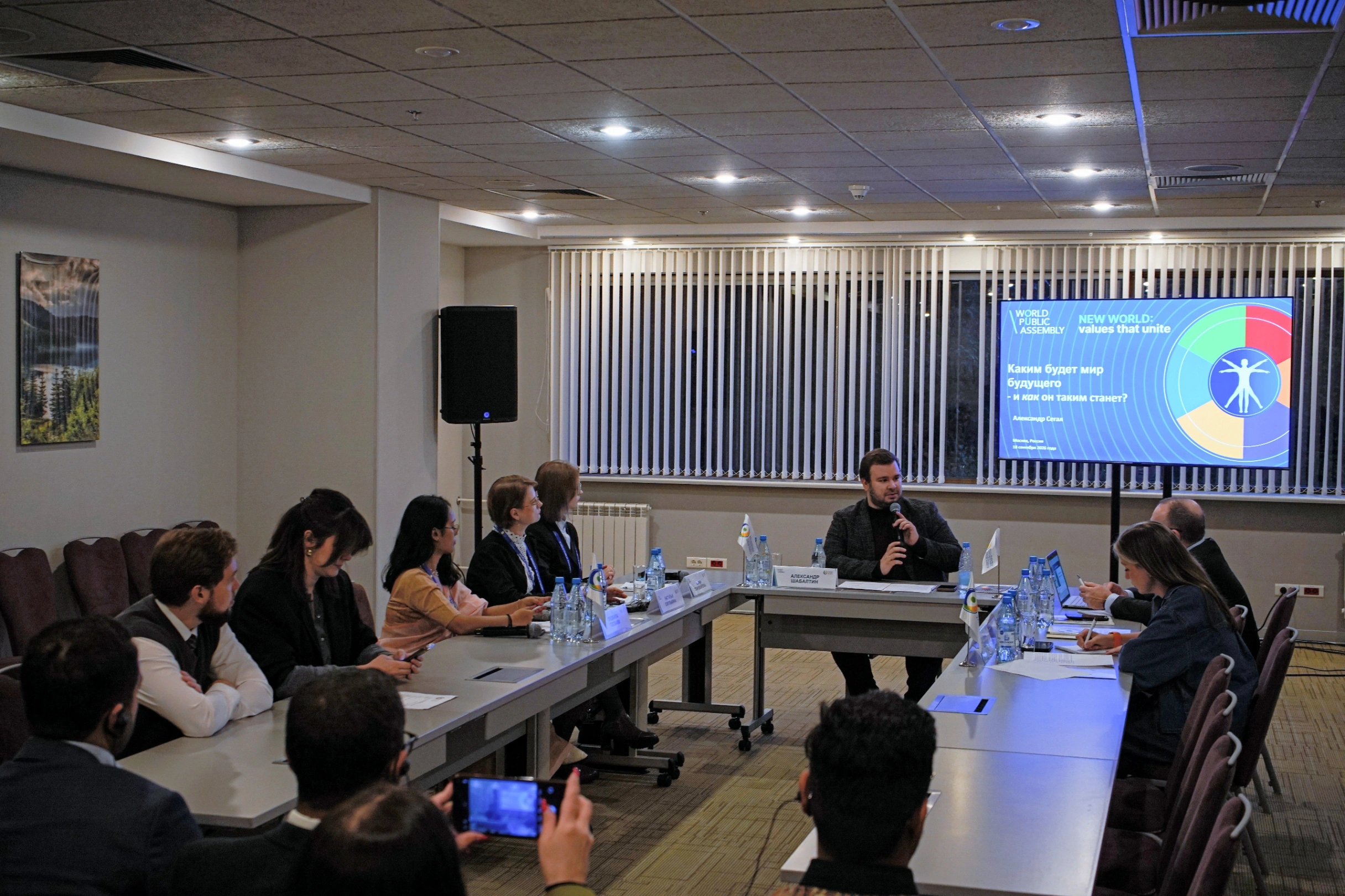
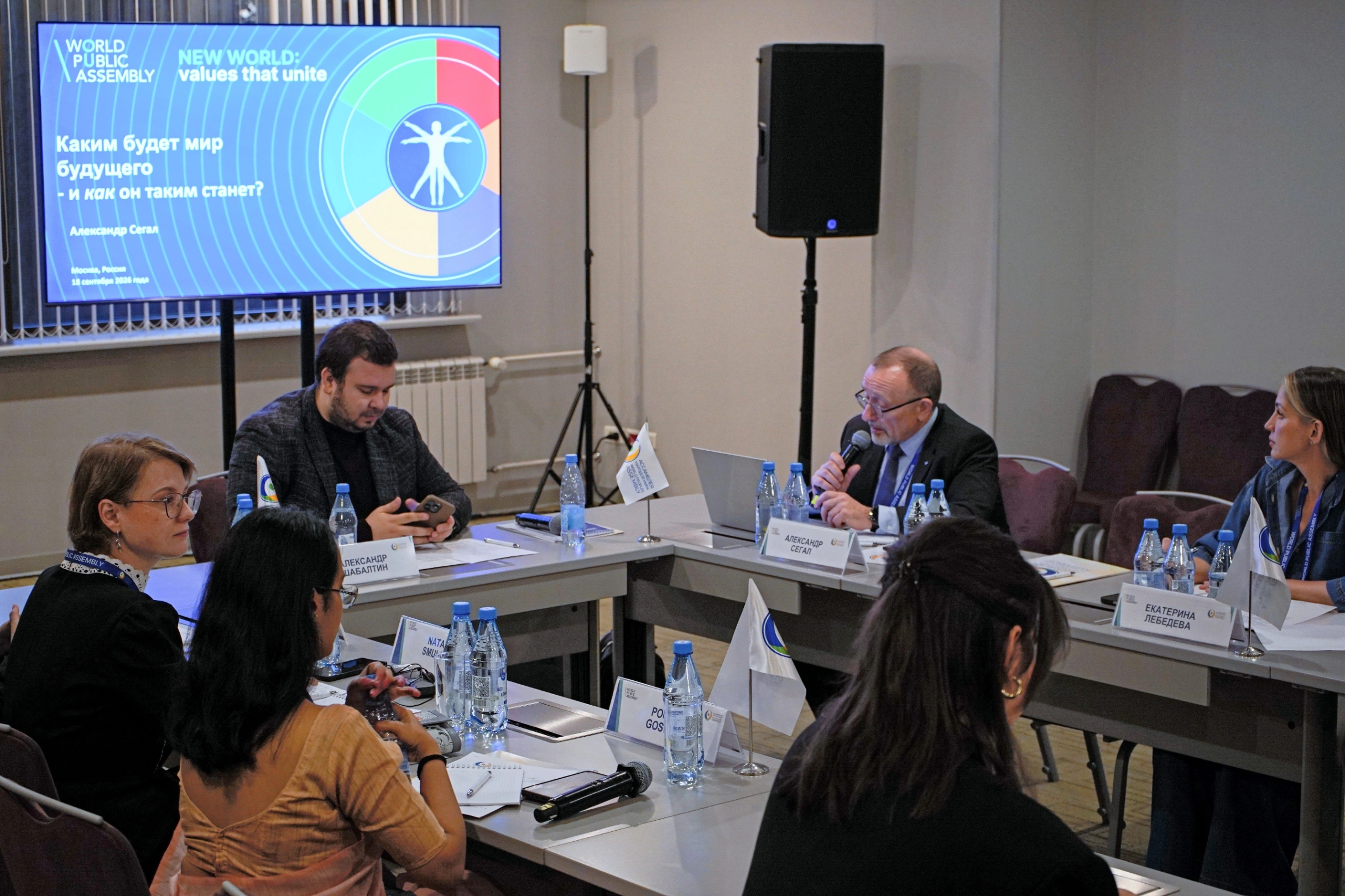
On September 18, 2026 at the World Trade Center took place the panel discussion «A Palette of Scenarios: What Will the World of the Future Be Like» as part of the II International Youth Forum “Generation of Unity”. The event was held as part of the Second World Public Assembly “New World: Values That Unite,” which took place in Moscow from September 18 to 19.
Participants discussed various approaches to modeling the future, impact of technological and social changes on development of society and place of Russia and the BRICS countries in the emerging system of international relations. The speakers paid special attention to the role of young people in defining value‑based guidelines and shaping long‑term development scenarios.
The discussion was moderated by Alexander Shabaltin, General Director of the Center for the Development of Humanitarian Technologies 'NOVAYA ERA' (New Era).
Alexander Segal, Senior Researcher at the Faculty of Philosophy of Lomonosov Moscow State University and Chief Expert of the “Civilizational Future of Russia” Philosophical Club, devoted his speech to the methodology of working with the image of the future. He noted that the idea of a desired future is not in itself sufficient for its realization. According to the speaker, the image needs to be consistently transformed into a concept and the concept - into a specific process that includes necessary conditions and sequence of actions.
As one of the tools for this approach, Alexander Segal presented a method of “archaeology of the future.” Its point is to start from a desired result and mentally recreate the conditions that need to be established at the previous stages to achieve it. This allows to view the future not as a pre‑determined picture, but as a sequential process of its formation.
Ekaterina Lebedeva, PhD in Political Sciences, Associate Professor at the Department of Political Science and Political Management at the Institute of Social Sciences of RANEPA, examined existing models of the future and their possible impact on development of Russia and BRICS countries. She drew attention to the difference between scenarios based on continuation of existing trends and target models that involve achieving a certain desired state. In her presentation the expert examined approaches to the future presented in various international concepts and studies and related ideas about technological, environmental, social and civilizational development.
The speaker also focused on technological transformation and how it is changing the role of the individual and the structure of society as a whole. According to Ekaterina Lebedeva, development of digital infrastructure, new technologies and management mechanisms requires Russia and the BRICS countries not only to adapt to external scenarios but also to independently define their own long‑term guidelines.
The speaker emphasized the importance of subjectivity - an ability to independently define goals and form mechanisms to achieve them. In this context, she linked design of the future with creation of specific institutional projects that would make it possible to move from a general vision of desired future to its practical implementation.
The participants of the discussion also became:
Angelina Bayeva— PhD in Philosophical Sciences, Senior Lecturer at the Department of Philosophy of Natural Sciences, Faculty of Philosophy, Lomonosov Moscow State University, Chairman of the SMU Faculty of Philosophy, Member of SMU of the Lomonosov Moscow State University;
Maria Starovoitova - sociologist and supervisor of the Laboratory of Public Thought at the NEW ERA Center for the Development of Humanitarian Technologies;
Natalia Smulkina - PhD in Political Sciences, Associate Professor of the Department of Sociology and Psychology of Politics, Faculty of Political Science, Moscow State University;
Pujita Goswami - expert and trainer in peacebuilding for the international youth program “The Duke of Edinburgh's International Award”.
During the discussion value orientations of younger generation, socio‑political perception of various development scenarios, issues of peacebuilding and the prospects of BRICS countries were considered among others.
Participants noted that a conversation about the future requires not only forecasting possible changes but also understanding mechanisms through which society and the state can influence formation of these changes. In this context, a combination of a long-term vision, scientific expertise and specific tools for its implementation is of particular importance.
Additional information is available on the official website of World Peoples Assembly or at media@world-assembly.org.